



Canadian Hard Water Report 2026
We ranked 31 Canadian cities by how hard their tap water is, using each city's or water utility's own latest water quality report. Hard water leaves scale in kettles, coffee makers, dishwashers and washers. Soft water has its own quirks. Here is where your city lands.
The hardest tap water in this report is in Kitchener-Waterloo (466 mg/L), 26 times harder than the softest, in Victoria and Saint John (18 mg/L). 9 of the 31 cities have hard or very hard water.
By BLITZ Canada. Data last reviewed October 24, 2026.
Every city on one scale
Total hardness in mg/L as calcium carbonate. The lines mark where water turns moderately hard, hard and very hard.
31 cities ranked, hardest to softest
Each city's figure is the median of its water systems, in mg/L as calcium carbonate. Open a city for every plant, the source report and dishwasher and softener settings.
| Rank | City | Hardness (mg/L) | Grains per gallon | Rating | Data |
|---|---|---|---|---|---|
| 1 | Kitchener-Waterloo Ontario | 466 mg/L2 water systems: 291 to 616 | 27.3 | Very hard | Region of Waterloo and City of Guelph (Water Softener Facts) |
| 2 | Guelph Ontario | 462 mg/LPublished range: 359 to 564 | 27.0 | Very hard | Region of Waterloo and City of Guelph (Water Softener Facts) |
| 3 | Regina Saskatchewan | 203 mg/L | 11.9 | Very hard | City of Regina, 2025 |
| 4 | Calgary Alberta | 199 mg/L2 water systems: 174 to 224 | 11.6 | Very hard | City of Calgary, 2025 |
| 5 | Saskatoon Saskatchewan | 177 mg/L | 10.4 | Hard | City of Saskatoon, 2023 |
| 6 | Edmonton Alberta | 173 mg/L | 10.1 | Hard | EPCOR, 2025 |
| 7 | Charlottetown Prince Edward Island | 168 mg/L | 9.8 | Hard | City of Charlottetown, 2025 |
| 8 | Markham, Vaughan and Richmond Hill Ontario | 127 mg/LPublished range: 125 to 128 | 7.4 | Hard | York Region, 2025 |
| 9 | Mississauga and Brampton Ontario | 123 mg/L2 water systems: 120 to 130 | 7.2 | Hard | Region of Peel, 2025 |
| 10 | Hamilton Ontario | 120 mg/L | 7.0 | Moderately hard | City of Hamilton |
| 11 | Toronto Ontario | 119 mg/L | 7.0 | Moderately hard | City of Toronto, 2025 |
| 12 | Montréal Quebec | 117 mg/L | 6.8 | Moderately hard | Ville de Montréal, 2024 |
| 13 | Longueuil Quebec | 115 mg/L2 water systems: 113 to 117 | 6.7 | Moderately hard | Ville de Longueuil, 2025 |
| 14 | London Ontario | 112 mg/L2 water systems: 106 to 118 | 6.5 | Moderately hard | Huron Erie Water (Lake Huron and Elgin Area water supply systems), 2026 |
| 15 | Windsor Ontario | 110 mg/LPublished range: 95 to 125 | 6.4 | Moderately hard | ENWIN Utilities |
| 16 | Drummondville Quebec | 90 mg/L | 5.3 | Moderately hard | Ville de Drummondville |
| 17 | Winnipeg Manitoba | 82 mg/L | 4.8 | Moderately hard | City of Winnipeg, 2025 |
| 18 | Sherbrooke Quebec | 73 mg/L | 4.3 | Moderately hard | Ville de Sherbrooke, 2025 |
| 19 | Saguenay Quebec | 71 mg/L7 water systems: 20 to 221 | 4.2 | Moderately hard | Ville de Saguenay, 2025 |
| 20 | Granby Quebec | 68 mg/LPublished range: 35 to 100 | 4.0 | Moderately hard | Ville de Granby |
| 21 | Blainville Quebec | 55 mg/LPublished range: 50 to 60 | 3.2 | Soft | Ville de Blainville |
| 22 | Terrebonne Quebec | 52 mg/L | 3.0 | Soft | Régie d'aqueduc intermunicipale des Moulins (RAIM), 2026 |
| 23 | Laval Quebec | 51 mg/L3 water systems: 50 to 61 | 3.0 | Soft | Ville de Laval, 2025 |
| 24 | Gatineau Quebec | 40 mg/L4 water systems: 32 to 45 | 2.3 | Soft | Ville de Gatineau, 2023 |
| 25 | Halifax Nova Scotia | 33 mg/L2 water systems: 18 to 48 | 1.9 | Soft | Halifax Water, 2026 |
| 26 | St. John's Newfoundland and Labrador | 30 mg/L2 water systems: 26 to 33 | 1.8 | Soft | Government of Newfoundland and Labrador, 2025 |
| 27 | Ottawa Ontario | 21 mg/L | 1.2 | Soft | City of Ottawa, 2025 |
| 27 | Vancouver British Columbia | 21 mg/L | 1.2 | Soft | Metro Vancouver, 2025 |
| 29 | Moncton, Dieppe and Riverview New Brunswick | 20 mg/L | 1.2 | Soft | City of Moncton, 2025 |
| 30 | Saint John New Brunswick | 18 mg/L | 1.1 | Soft | City of Saint John, 2025 |
| 30 | Victoria British Columbia | 18 mg/L | 1.1 | Soft | Capital Regional District, 2025 |
Cleaners for the machines your water runs through
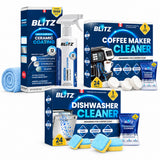
Hard water leaves scale in coffee makers and ice machines, and every water leaves residue and odours in dishwashers and washers. These are the BLITZ cleaners for each one.

Coffee Maker Cleaner
Removes limescale, mineral buildup and coffee oils inside your coffee maker.
Descales for better-tasting coffee

Dishwasher Cleaner
Dissolves grease, detergent residue and limescale buildup, and removes odour-causing buildup.
Clears grease, limescale and odour buildup

Washing Machine Cleaner
Breaks down residue and odour-causing buildup inside your washer.
Removes odour and buildup from the drum and hoses

Ice Machine Cleaner
Removes mineral buildup and odours inside your ice machine.
Descales and freshens ice machines
Why hardness varies so much across Canada
Hardness is mostly calcium and magnesium that water picks up from rock and soil. The longer water stays in contact with limestone and other mineral-rich ground, the harder it gets. That is why the hardest water in this report comes from wells: Guelph and much of Kitchener-Waterloo drink groundwater drawn from limestone and dolostone bedrock.
Prairie water is hard too. Calgary and Edmonton treat rivers that start in the Rocky Mountains, and Regina and Saskatoon treat prairie lake and river water. Their figures move with the seasons: Calgary says its hardness is lowest during spring snowmelt.
Great Lakes and St. Lawrence cities sit in the middle. Toronto (119 mg/L), Hamilton (about 120 mg/L) and Mississauga and Brampton all treat Lake Ontario water close to the 120 mg/L line between moderately hard and hard, and Montréal's St. Lawrence water is close behind at 117 mg/L.
The softest water runs off rock that gives up few minerals: the Ottawa River, which drains the Canadian Shield and supplies Ottawa and Gatineau, the rain and snow fed reservoirs in the mountains behind Vancouver, and the lakes that supply Halifax.
Soft water is a story too
At the soft end, limescale is not the issue. Vancouver's reservoir water measures about 3.6 mg/L before treatment, and Halifax's two lakes about 4.1 and 4.3 mg/L. Water that soft can be hard on pipes, so Metro Vancouver adds lime at its Seymour-Capilano plant to raise the pH and alkalinity. That lifts the hardness to about 21 mg/L, which is still soft.
Soft water lathers easily, so it is easy to use more detergent than you need. The extra stays behind as residue in dishwashers and washers, where it mixes with grease, food and lint and starts to smell. In soft-water cities, use the lower dose on the detergent label and clean the dishwasher and the washer about every two weeks.
The five softest cities
- Victoria 18 mg/L
- Saint John 18 mg/L
- Moncton, Dieppe and Riverview 20 mg/L
- Vancouver 21 mg/L
- Ottawa 21 mg/L
By province
The report covers the cities we have an official figure for, so a province's row only describes those cities.
| Province | Cities | Hardest | Softest |
|---|---|---|---|
| British Columbia | 2 | Vancouver, 21 mg/L | Victoria, 18 mg/L |
| Alberta | 2 | Calgary, 199 mg/L | Edmonton, 173 mg/L |
| Saskatchewan | 2 | Regina, 203 mg/L | Saskatoon, 177 mg/L |
| Manitoba | 1 | Winnipeg, 82 mg/L | Only city in the report |
| Ontario | 9 | Kitchener-Waterloo, 466 mg/L | Ottawa, 21 mg/L |
| Quebec | 10 | Montréal, 117 mg/L | Gatineau, 40 mg/L |
| New Brunswick | 2 | Moncton, Dieppe and Riverview, 20 mg/L | Saint John, 18 mg/L |
| Nova Scotia | 1 | Halifax, 33 mg/L | Only city in the report |
| Prince Edward Island | 1 | Charlottetown, 168 mg/L | Only city in the report |
| Newfoundland and Labrador | 1 | St. John's, 30 mg/L | Only city in the report |
What counts as hard water?
We use the U.S. Geological Survey scale, in mg/L as CaCO₃.
- Soft 0 to 60 mg/L
- Moderately hard 61 to 120 mg/L
- Hard 121 to 180 mg/L
- Very hard Over 180 mg/L
How to read the units
Utilities usually report hardness in mg/L as calcium carbonate (CaCO₃), which is the same as ppm. Dishwasher and softener manuals often use grains per gallon or German degrees instead. Here is how they convert:
- 1 US grain per gallon = 17.1 mg/L
- 1 imperial grain per gallon = 14.25 mg/L
- 1 °dH = 17.85 mg/L
- 1 mmol/L = 100.09 mg/L
Add a water hardness badge to your site
Free for local news, plumbers, real estate agents, schools and anyone writing about their city's water. Pick a city, copy the code and paste it into your page's HTML. The badge links to the city's page, so your readers can check the source.
How we built this report
- Every figure comes from a published source that we link to, almost always the city's or the utility's own water quality report.
- Hardness means total hardness in mg/L as calcium carbonate (CaCO₃), which is the same as ppm. Grains per gallon are US grains: 1 grain per gallon is 17.1 mg/L.
- When a source gives a range instead of an average, we use the middle of the range.
- When a city has more than one water system, its figure is the median of those systems. The city's own page shows every one. A supply that serves only a small part of a city is shown on the city's page but left out of its figure.
- Ratings use the U.S. Geological Survey scale: soft up to 60 mg/L, moderately hard from 61 to 120, hard from 121 to 180 and very hard above 180.
- Figures describe municipal tap water. Private wells and homes with a water softener are not covered.
- We use the newest report each city had published when we checked. Each city page shows the period it covers and the date we checked it.
The figures and the ranking are free to reuse under the Creative Commons Attribution 4.0 licence. Please credit BLITZ Canada and link to this page.
Cite this report
BLITZ Canada, Canadian Hard Water Report 2026, https://goblitzclean.com/pages/canadian-hard-water-report (data reviewed October 24, 2026).
You are welcome to reuse the figures and the ranking with a link to this page.
Questions and answers
Which Canadian city has the hardest water?
Of the 31 cities in this report, the hardest tap water is in Kitchener-Waterloo (466 mg/L), followed by Guelph (462 mg/L) and Regina (203 mg/L).
Which Canadian city has the softest water?
Of the 31 cities in this report, the softest tap water is in Victoria (18 mg/L), followed by Saint John (18 mg/L) and Moncton, Dieppe and Riverview (20 mg/L).
How many Canadian cities have hard water?
9 of the 31 cities in this report have hard or very hard water, meaning over 120 mg/L. 11 have soft water, at 60 mg/L or less.
Is hard water bad for your health?
Canadian guidance treats hardness as an operational issue, not a health one. Health Canada says 80 to 100 mg/L gives an acceptable balance between corrosion and scale, and that water above 200 mg/L is considered poor but has been tolerated by consumers.
How are the cities ranked?
By total hardness in mg/L as calcium carbonate, from each city's own water quality report. A city with several water systems is ranked by the median of those systems, and a source that only gives a range counts as the middle of that range.
Check your own water
Enter your postal code to see your water system's figure and what it means for your appliances.