Hard water checker

How hard is your water?

Pick your city or enter your postal code to see how hard your tap water is, straight from your city's latest water quality report. We show it in mg/L and in the other units you might see on a dishwasher, a softener or a test strip.

or

Choose a city or enter a postal code to see your result.

Postal code matching uses the first three characters and is approximate near city limits.

Hardness by city

Every number links to the report it comes from. Cities on the same water supply share a page.

City Water system Hardness (mg/L) Rating Source
Calgary Alberta Bearspaw plant (mostly north Calgary) 174 Hard City of Calgary 2025, annual summary
Glenmore plant (mostly south Calgary) 224 Very hard City of Calgary 2025, annual summary
Edmonton Alberta EPCOR treatment plants 173 Hard EPCOR January to November 2025
Regina Saskatchewan City of Regina distribution system 203 Very hard City of Regina 2025, comprehensive annual sample
Saskatoon Saskatchewan City of Saskatoon treated water 177 Hard City of Saskatoon 2023, year-end summary
Kitchener-Waterloo Ontario Kitchener and Waterloo 291 to 616 Very hard Region of Waterloo and City of Guelph (Water Softener Facts) Range published by the source, no date given
Cambridge 342 to 616 Very hard Region of Waterloo and City of Guelph (Water Softener Facts) Range published by the source, no date given
Guelph Ontario City of Guelph 359 to 564 Very hard Region of Waterloo and City of Guelph (Water Softener Facts) Range published by the source, no date given
Toronto Ontario City of Toronto 119 Moderately hard City of Toronto 2025, annual analysis summary
Montréal Quebec Atwater and Charles-J.-Des Baillets plants 117 Moderately hard Ville de Montréal 2024, annual report
Laval Quebec Chomedey plant 51 Soft Ville de Laval 2025, treated water average
Pont-Viau plant 50 Soft Ville de Laval 2025, treated water average
Sainte-Rose plant 61 Moderately hard Ville de Laval 2025, treated water average
Longueuil Quebec Louise-Gravel plant 113 Moderately hard Ville de Longueuil 2025, distributed water, annual average
Le Royer plant 117 Moderately hard Ville de Longueuil 2025, distributed water, annual average
Gatineau Quebec Aylmer sector (Aylmer plant) 32 Soft Ville de Gatineau September 2023, one sample of distributed water
Hull sector (Hull plant) 45 Soft Ville de Gatineau September 2023, one sample of distributed water
Gatineau sector (Gatineau plant) 40 Soft Ville de Gatineau September 2023, one sample of distributed water
Buckingham and Masson-Angers sectors (Buckingham plant) 40 Soft Ville de Gatineau September 2023, one sample of distributed water
Sherbrooke Quebec J.-M.-Jeanson plant 73 Moderately hard Ville de Sherbrooke 2025, treated water leaving the plant
Winnipeg Manitoba City of Winnipeg distribution system 82 Moderately hard City of Winnipeg 2025, distribution system test results

What counts as hard water?

We use the U.S. Geological Survey scale, in mg/L as CaCO₃.

  • Soft 0 to 60 mg/L
  • Moderately hard 61 to 120 mg/L
  • Hard 121 to 180 mg/L
  • Very hard Over 180 mg/L

How to read the units

Utilities usually report hardness in mg/L as calcium carbonate (CaCO₃), which is the same as ppm. Dishwasher and softener manuals often use grains per gallon or German degrees instead. Here is how they convert:

  • 1 US grain per gallon = 17.1 mg/L
  • 1 imperial grain per gallon = 14.25 mg/L
  • 1 °dH = 17.85 mg/L
  • 1 mmol/L = 100.09 mg/L

Questions and answers

What is hard water?

Hard water carries dissolved minerals, mainly calcium and magnesium. When it is heated or dries, those minerals leave scale behind: the white, chalky crust you see in kettles, in coffee makers and on taps.

What counts as hard water?

We use the U.S. Geological Survey scale: 0 to 60 mg/L is soft, 61 to 120 is moderately hard, 121 to 180 is hard, and over 180 is very hard.

Is hard water a health concern?

Canadian guidance treats hardness as an operational issue, not a health one. Health Canada says 80 to 100 mg/L gives an acceptable balance between corrosion and scale, and that water above 200 mg/L is considered poor but has been tolerated by consumers.

Why does my city's number change during the year?

River water changes with the seasons. On the Prairies, hardness tends to peak in winter: south Calgary ran 208 to 274 mg/L from January to March 2025, and February was Edmonton's hardest month. Calgary says hardness is lowest during spring snowmelt.

Where do these numbers come from?

Each figure comes from a published source that we link to, usually the utility's own report or open data. We show the period it covers when the source gives one, and the date we checked it. We only list a water system once we have found a figure we can cite, so some cities are not here yet.

My city isn't listed. What should I do?

Look for your municipality's annual drinking water quality report. Most list total hardness, usually in mg/L as CaCO₃, so you can compare it with the scale on this page.

Which BLITZ products help with hard water?

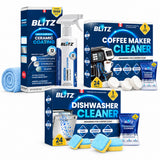
Our coffee maker cleaner tablets, ice machine cleaner and dishwasher cleaner remove limescale and mineral buildup. Our washing machine cleaner breaks down the residue and odours that build up in a machine you run every week.

Guides for hard water

Data last reviewed October 17, 2026.