



Hard Well Water: Testing, Iron and Manganese Stains, and Scale
Québec’s Environment ministry says to have an accredited lab test a well for bacteria twice a year (spring and fall) and for chemistry, including hardness, iron and manganese, at least once. White crust means hardness, orange stains point to iron (Health Canada’s aesthetic objective: 0.1 mg/L), black stains to manganese (0.02 mg/L aesthetic, 0.12 mg/L health limit). Treat from the lab results. Then let BLITZ handle the scale your appliances still pick up: one tablet helps prevent limescale in the toilet, and one tablet a clean takes scale out of the dishwasher, washer and coffee maker.

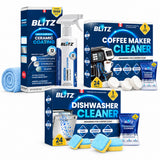
Shop the BLITZ Whole Home Kit, $89.95
In this guide
Orange, black or white stains from well water: what each colour means
Groundwater picks up minerals from the rock it moves through: calcium and magnesium make it hard, iron and manganese make it stain. The Québec government says deep drilled wells (often called artesian wells) are more likely to carry these natural metals and minerals.
The colour tells you what to test for:
- White or beige crust in the kettle, on taps and at the toilet waterline: hardness.
- Orange or reddish-brown stains in the sink, toilet or laundry: iron. Penn State Extension notes iron water can come out clear, then turn orange-brown as it stands.
- Black or dark brown stains, or black specks: manganese, often alongside iron.
- Orange-brown slime in the toilet tank: often iron bacteria. Health Canada notes that iron in water can promote their growth.
- A rotten-egg smell: hydrogen sulphide, which Health Canada limits to 0.05 mg/L for taste and odour.

Iron and manganese in well water: Health Canada's limits
Compare your results with the Guidelines for Canadian Drinking Water Quality: an aesthetic objective (AO) covers colour, taste, odour and stains; a maximum acceptable concentration (MAC) covers health.

- Iron: AO of 0.1 mg/L, set on December 27, 2024 (many charts still show the old 0.3). Above 0.05 mg/L, Health Canada says laundry and fixtures may stain. Iron has no health limit.
- Manganese: AO of 0.02 mg/L and MAC of 0.12 mg/L. Québec made 0.12 mg/L a standard under its Règlement sur la qualité de l'eau potable on June 21, 2024, and says it also applies to private wells.
- Hardness: no guideline. Health Canada calls 80 to 100 mg/L an acceptable balance between corrosion and scaling, over 200 mg/L poor but tolerated, and over 500 mg/L unacceptable for many household uses.
- Sodium: AO of 200 mg/L, based on taste. It matters if you add a softener.
Careful: If manganese is above 0.12 mg/L, call your regional public health office (direction de santé publique) before using the water for baby formula: Health Canada says formula-fed infants may be especially at risk. It also says bathing and showering in that water is safe.
How to test well water in Québec
In Québec, the well owner is responsible for the water. The Environment ministry (MELCCFP) points to section 3 of the Règlement sur la qualité de l'eau potable: the owner must supply drinkable water to family and visitors.

- Find an accredited lab on the Ministry's list of accredited drinking water labs (in French, by region).
- Order the right tests. Bacteria (E. coli, enterococci, total coliforms) every spring and fall. Chemistry (arsenic, manganese, barium, nitrates-nitrites, chlorides, sodium, iron, sulphates, fluoride, total hardness) at least once while you use the well.
- Use the lab's bottles and follow its instructions, which Health Canada says makes results reliable.
- Read the report. The lab tells you right away if a standard is exceeded; report a chemical exceedance to your regional public health office, as the Ministry recommends.
- Test again after a sudden change in taste, smell or look, or work on the well or the land around it.
Tip: Send a treatment dealer your lab report, not a photo of the stains. If you treat your water, our suggestion is to retest every two years, as Health Canada advises for general water quality.
After a flood, the Ministry treats any well in the flooded area as not drinkable: check the equipment, wait at least ten days, shock-chlorinate, and drink again only after two rounds of good results (steps on La qualité de l'eau de mon puits, in French).
Softener, iron filter or sediment filter?

- Water softener (for hardness). Health Canada calls softeners the best available technology for hardness; look for NSF/ANSI 44, the residential softener standard it cites. Softeners also take out some dissolved iron and manganese, less well in very hard water, and rust particles foul the resin (Penn State).
- Iron filter (for iron and manganese). Health Canada names manganese greensand filters for discoloured water and staining, and NSF/ANSI 42 certification for iron. They need regular regeneration: a poorly maintained one can release iron into the tap water.
- Sediment filter (for particles). A cartridge that catches sand, silt and rust flakes; dissolved iron, manganese and hardness pass straight through. Installers often put it first so particles don't reach the other units: ask yours.
None of these makes unsafe water safe: bacteria need their own solution. Above the manganese health limit, Health Canada calls reverse osmosis at the tap the most effective option for drinking water. Whatever you install, test the water going in and coming out.
Careful: A softener adds sodium: Health Canada recommends a kitchen tap that bypasses it, and says children under 8 generally shouldn't drink softened water. On a septic system, before buying a softener or any treatment unit, Québec's Environment ministry recommends asking the professional who designed the system whether it can take that unit's wastewater (see our septic tank guide).
What hard well water does to your appliances
Anything that heats water scales up first (heated hard water leaves calcium carbonate, says the U.S. Geological Survey). A well often adds orange or black stains on laundry and in the toilet bowl.
The cleaning steps are in our guide to removing hard water buildup from appliances; for a ring in the bowl, see the toilet ring guide by colour. Our suggestion on hard well water: clean the dishwasher, washer and coffee maker every two weeks, and put a fresh tablet in each toilet tank monthly.

Keeping appliances scale-free on well water with BLITZ
Your treatment unit handles the water; BLITZ handles the scale that still builds up where water gets heated or sits. One tablet per clean. Prices on goblitzclean.com, checked October 20, 2026:
| Where | What BLITZ does | Price and cost |
|---|---|---|
| Toilet | Automatic Toilet Bowl Cleaner: one tablet in the tank helps prevent limescale and keep a new ring from forming (4.8 out of 5, 18 reviews) | $25.95 for 12, about $2.16 a month |
| Dishwasher | Dishwasher Cleaner & Deodorizer: removes grease, grime and limescale buildup (5.0 out of 5, 15 reviews) | $23.95 for 24, about $1.00 a clean ($23.95 ÷ 24) |
| Washer | Washing Machine Cleaner & Descaler: breaks down detergent residue and mineral deposits (4.9 out of 5, 14 reviews) | $24.95 for 24, about $1.04 a clean |
| Coffee maker | Coffee Maker Cleaner: breaks down mineral scale and coffee oil residue (4.8 out of 5, 14 reviews) | $24.95 for 24, about $1.04 a clean |
| Shop the Whole Home Kit |
Already have a ring? Scrub it off once, then drop a tablet in the tank and let it help keep the next one from forming.

- Septic-safe: every BLITZ product, which matters if you also have a septic tank.
- A year in one box: one tablet per cycle; a box of 24 lasts about a year at two cleans a month.
- A Québec company based in Laval, with service in French and English. Free shipping in Canada from $40 ($7.95 under), most orders in 2 to 3 business days, 10% back in store credit on goblitzclean.com and a 30-day money-back guarantee (see our refund policy). Also on Amazon.ca.
Frequently asked questions
Is well water safe to drink?
Only an accredited lab test can tell you: clear, odourless water can still carry bacteria or nitrates.
How often should I test my well water in Québec?
Bacteria twice a year (spring and fall), and hardness, iron, manganese and the other chemistry at least once, says Québec's Environment ministry. Retest after any change, work on the well or a flood.
What is an acceptable level of iron in well water?
Health Canada's aesthetic objective is 0.1 mg/L of total iron, lowered from 0.3 mg/L in December 2024. It's about colour and stains, not health; staining can start above 0.05 mg/L.
Why is my well water leaving orange, brown or black stains?
Orange to reddish-brown usually means iron; black or dark brown usually means manganese, often with iron. Get both tested, since manganese also has a health limit of 0.12 mg/L.
Will a water softener remove iron?
Some dissolved iron, less well in very hard water, and rust particles foul the resin. For higher iron or manganese, Penn State Extension points to an iron filter ahead of the softener.
What do BLITZ tablets do on hard well water?
They keep the appliances working while your treatment unit handles the water. The toilet tablet helps prevent limescale in the bowl for a month; the dishwasher, washer and coffee maker tablets break down scale and residue, one tablet per clean, about $1.00 to $1.04 each. All are septic-safe.
Sources: Health Canada (drinking water guidelines summary table, iron, manganese, operational parameters, Be Well Aware); Québec's Environment ministry (MELCCFP): La qualité de l'eau de mon puits, its septic system best practices guide and the CEAEQ lab list; Québec.ca (manganese, well water analysis); Penn State Extension; U.S. Geological Survey. All checked October 19 and 20, 2026.
A YEAR OF SCALE CARE, THREE APPLIANCES
BLITZ Whole Home Kit
Washing Machine Cleaner, Dishwasher Cleaner and Coffee Maker Cleaner (24 tablets each, about a year) plus Home Ceramic Coating, so water spots wipe off glass and plain stainless faster. Septic-safe. $89.95, $22.89 less than buying them separately.

For the toilets: the Automatic Toilet Bowl Cleaner, $25.95 for 12 tablets, one per tank each month.


