

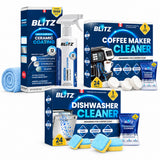


Hard Water Buildup in Appliances: Signs and Fixes, Appliance by Appliance
Hard water buildup is limescale, the white crust calcium and magnesium leave when water is heated or dries. Remove it appliance by appliance: one BLITZ tablet and one cycle in the coffee maker, dishwasher, washer or countertop ice maker; a descaler or vinegar boil for the kettle; a vinegar soak for the shower head; a scrub, then a monthly tank tablet, for the toilet. Then clean on a rhythm that matches your water: Laval and Gatineau are soft, Montréal and Longueuil sit just under hard, the Prairies are very hard.

Shop the BLITZ Whole Home Kit, $89.95
In this guide
Each appliance shows limescale its own way and needs its own fix. Here's the overview, then the details.

What is hard water buildup?
Hard water carries dissolved calcium and magnesium. The U.S. Geological Survey explains that when hard water is heated, solid deposits of calcium carbonate can form. That's the white or beige crust in a kettle, the scale that slows a coffee maker and the film on a shower door after the water dries.
It's an appliance problem, not a health one. Health Canada sets no health limit for hardness, but says it scales hot water pipes, kettles and household appliances. USGS adds that scale makes electric water heaters less efficient and can clog pipes.
How it's measured: in mg/L as calcium carbonate, on the USGS scale:
- Soft: 0 to 60 mg/L
- Moderately hard: 61 to 120 mg/L
- Hard: 121 to 180 mg/L
- Very hard: over 180 mg/L
Manuals often use grains per gallon: divide mg/L by 17.1 (117 mg/L is about 7 grains).
How hard is the water in your city?
From each city's own water quality report, the same data as our hard water checker:
- Montréal (moderately hard, close to the line): 117 mg/L on average in 2024 (Atwater and Des Baillets network), from 109 to 126. See the Montréal hard water page.
- Longueuil (moderately hard): 113 mg/L at the Louise-Gravel plant and 117 at Le Royer in 2025. Longueuil's numbers by plant.
- Sherbrooke (moderately hard, soft side): 73.4 mg/L on average in 2025. See the Sherbrooke page.
- Laval (soft): 50.3 to 61.3 mg/L across its three plants in 2025, with only Sainte-Rose just over the 60 line. Laval's numbers by plant.
- Gatineau (soft): 32 to 45 mg/L, depending on the sector (2023 samples). See the Gatineau page.
- Québec City and Saguenay: Québec City calls its water very soft to moderately soft. Chicoutimi measured 41 mg/L in 2025, but La Baie 221: very hard.
- Outside Québec: Toronto 119, Edmonton 172.7, north Calgary 174, Regina 203 and south Calgary 224 mg/L.

What this means in Québec: most city water here is soft or moderately hard, so buildup takes months, not weeks. But a kettle or coffee maker that heats water every day still scales up, even in Laval.
Tip: On a private well, hardness can be far higher than any city's, and orange or black stains come from iron or manganese, not calcium. Test before you treat: our hard well water guide explains what to test and how.
How to remove hard water buildup, appliance by appliance
Use one product at a time: Health Canada warns that bleach reacts with acids, including vinegar, and releases toxic gases.
Kettle
Signs: a white or beige crust on the bottom, flakes floating in your tea.
- Use a descaler if you have one. KitchenAid recommends a commercial descaler for its electric kettles.
- Or use vinegar. KitchenAid's method: white vinegar to the 0.5 L mark, water to the 1 L mark, boil, then let it stand overnight.
- Empty and rinse. Fill with fresh water, boil and pour it out. Do it twice so no taste is left.
Coffee maker
Signs: slower brewing, white specks in the reservoir, a descale light. Keurig says scale can hinder brewer performance and recommends descaling every 3 to 6 months (every 3 with mineral-rich water). Nespresso says every 3 months or 300 capsules for the Vertuo Next.
Fix: one BLITZ Coffee Maker Cleaner tablet in the water tank of a drip or espresso machine, then a brew or descale cycle without coffee (in a pod machine, the tablet goes in the pod holder, largest cup size).
Then one full cycle of fresh water to rinse. It breaks down mineral scale and coffee oil residue; with heavy scale, run a second tablet. Brand-by-brand steps are in our coffee maker limescale guide; for a Keurig descale light, see how to descale a Keurig.
Dishwasher
Signs: white film on glasses, chalky residue on the tub floor and around the filter. Samsung Canada names chalk-like residue as a sign of hard water. Whirlpool says its dishwashers work best under 15 grains per gallon (about 257 mg/L).
- Do the vinegar test on a cloudy glass. If a vinegar-dampened cloth lifts the film, it's minerals; if not, it may be permanent etching. Our white film on dishes guide covers both.
- Rinse the filter under hot water and scrape off any crust.
- Clean the empty dishwasher: one BLITZ Dishwasher Cleaner tablet in the detergent compartment, one normal cycle. It removes grease, grime and limescale buildup.
- Keep the rinse aid full. Whirlpool says rinse aid minimizes the repeat buildup of white film.

Washing machine
Signs: a chalky crust in the detergent drawer and on the drum, residue that comes back soon after you clean. USGS explains that soap reacts with calcium to form soap scum. Whirlpool recommends cleaning a washer at least monthly, and more often with hard water.
Fix: one BLITZ Washing Machine Cleaner & Descaler tablet in the empty drum (never the drawer), on the hottest cycle or your washer's Tub Clean cycle. It breaks down detergent residue, grime and mineral deposits in front-load, top-load and HE washers. See how often to clean your washing machine.
Ice makers
Signs: white flakes in a glass as the ice melts, a white crust on the tray or sensors. Whirlpool explains that those particles are minerals in your water, usually calcium carbonate, common with hard water.
Countertop ice machine: one BLITZ Ice Machine Cleaner tablet every 1 to 2 months (more if it runs every day) removes mineral deposits and limescale, including in the internal water lines. The GE Profile Opal 2.0 even turns on a Descale light after 100 hours of ice making. Full steps in our ice machine cleaning guide.
Ice maker built into a fridge: BLITZ isn't made for those. Whirlpool says to replace the water filter every 6 months, but minerals aren't on its list of what the filter reduces.

Toilet
Signs: a white, beige or grey ring at the waterline that a brush doesn't remove. A brown, orange or black ring usually points to iron or manganese, often from a well.
Fix: scrub the ring off once (our toilet ring guide explains how, by colour). Then drop one BLITZ Automatic Toilet Bowl Cleaner tablet in the tank (not the bowl). It's bleach-free, helps keep a new ring from forming and lasts up to 30 days or 300 flushes.

Shower head and glass
Signs: spray holes that clog or spray sideways, white spots on the glass door and chrome.
- Soak the shower head. Delta's method: equal parts white vinegar and water, enough to cover the head, about 30 minutes. Then rub the spray face with a soft cloth or toothbrush, rinse and dry.
- Skip abrasives. Delta warns they could damage the finish.
- Protect the glass. On clean, dry glass, tile and chrome, BLITZ Home Ceramic Coating leaves an invisible water-repellent finish that helps reduce water spots, soap scum and mineral buildup for up to 12 months. Let it cure about 2 hours; not for floors.
Get the washer, dishwasher, coffee and coating in one kit
How to keep hard water buildup from coming back
- Clean on a rhythm that matches your water (below), not when the machine slows down.
- Keep the dishwasher's rinse aid full. Bosch recommends separate rinse aid even when the detergent contains some.
- Dose detergent for your water. Tide and GE both say hard water needs more, soft water less.
- Use filtered water in the coffee maker if the maker suggests it, as Keurig does.
- Consider a water softener for very hard water. Health Canada calls them the best available technology to reduce hardness, and GE recommends one from 12 grains (about 205 mg/L).
Careful: A softener adds sodium to the water. Health Canada recommends that the kitchen tap bypass it, and that children under 8 not drink softened water. Whirlpool also strongly advises against connecting a fridge ice maker to softened water.

Vinegar, citric acid or a descaler?
All three dissolve limescale. Vinegar does the job in a kettle (KitchenAid's method) and on a shower head (Delta's). In a coffee maker, dishwasher, washer or ice maker, a BLITZ tablet is simpler: made for one appliance, no vinegar smell, and one tablet per clean for about $1. More in our guide to citric acid vs. vinegar for appliances.
What BLITZ covers, and what it costs
One tablet, one cycle. Prices on goblitzclean.com, checked October 19, 2026:
| Appliance | BLITZ product | Price and cost per use |
|---|---|---|
| Coffee maker | Coffee Maker Cleaner, 24 tablets (4.8 out of 5, 14 reviews) | $24.95, about $1.04 a clean |
| Dishwasher | Dishwasher Cleaner & Deodorizer, 24 tablets (5.0 out of 5, 15 reviews) | $23.95, about $1.00 a clean |
| Washer | Washing Machine Cleaner & Descaler, 24 tablets (4.9 out of 5, 14 reviews) | $24.95, about $1.04 a clean |
| Countertop ice maker | Ice Machine Cleaner, 24 tablets (4.9 out of 5, 13 reviews) | $24.95, about $1.04 a clean |
| Toilet | Automatic Toilet Bowl Cleaner, 12 tablets (4.8 out of 5, 18 reviews) | $25.95, about $2.16 a month |
| Shower glass, chrome | Home Ceramic Coating Spray Kit, 236 mL (4.9 out of 5, 16 reviews) | $38.99, up to 12 months, up to 1,000 sq ft |
| Four at once | Whole Home Kit: washer, dishwasher, coffee maker, ceramic coating | $89.95, $22.89 less than buying them separately |
| Shop the Whole Home Kit |
- A year in a box of 24 tablets, and every BLITZ product is septic-safe.
- A Québec company based in Laval, with service in French and English.
- Free shipping in Canada from $40 ($7.95 under), most orders in 2 to 3 business days, and 10% back in store credit on goblitzclean.com. Also on Amazon.ca.
- A 30-day money-back guarantee (see our refund policy).
Frequently asked questions
How do you remove hard water buildup from appliances?
Run a descaler made for each appliance, then rinse. One BLITZ tablet does it in one cycle in the coffee maker, dishwasher, washer or countertop ice maker; for a kettle or shower head, use the maker's descaler or vinegar method.
Is hard water bad for you?
No. Health Canada says hardness has low potential for toxicity and sets no health limit. The problem is scale in kettles, water heaters and appliances.
Is Montréal water hard?
Moderately hard, close to the line: 117 mg/L on average in 2024, and water counts as hard above 120. Laval and Gatineau are soft. Check your city on our hard water page.
What are the white flakes in my ice?
Minerals from your water, usually calcium carbonate, according to Whirlpool. In a countertop ice machine, they also mean scale is building inside: clean it every 1 to 2 months.
Does a water softener stop limescale?
It reduces it a lot: Health Canada calls softeners the best available technology for reducing hardness. You'll still need to clean the washer, dishwasher and coffee maker for detergent, grease and coffee oils.
How often should I descale with hard water?
Our suggestion: every two weeks for the washer, dishwasher and coffee maker, monthly for the kettle and countertop ice maker.
Sources: U.S. Geological Survey; Health Canada (Guidelines for Canadian Drinking Water Quality, operational parameters; bleach safety); water quality reports from Montréal, Longueuil, Laval, Gatineau, Sherbrooke, Québec City, Saguenay, Toronto, Edmonton, Calgary and Regina; KitchenAid, Keurig Canada, Nespresso, Whirlpool, Samsung Canada, GE Appliances, Bosch, Tide Canada and Delta support pages and manuals. All checked October 19 and 20, 2026.
KitchenAid, Keurig, Nespresso, Whirlpool, Samsung, GE, Bosch, Tide and Delta are trademarks of their owners. BLITZ is not affiliated with them.
A YEAR OF DESCALING, FOUR APPLIANCES
BLITZ Whole Home Kit
Washing Machine Cleaner, Dishwasher Cleaner and Coffee Maker Cleaner (24 tablets each, about a year) plus Home Ceramic Coating for glass and chrome. $89.95, $22.89 less than buying them separately.


