



Septic Tank Cleaning Products: What to Avoid, What's Fine and When to Pump
Normal cleaning at the label dose is fine with a septic tank: Québec's environment ministry asks you to use household cleaners in moderation, not to give them up. What hurts it: drain openers, paint, solvents, medication, grease, wipes, pool chlorine, big doses of any cleaner, frequent garburator use and additives. And Québec requires pumping at least every 2 years for a year-round home, every 4 years for a seasonal one. Every BLITZ product is septic-safe when used as directed, and it’s one tablet per clean, the same small dose every time.

Shop BLITZ toilet tablets, $25.95
In this guide

What not to put in a septic tank
Québec's ministry says some products harm the tank's treatment and can contaminate groundwater, while others add sludge, clog the pre-filter early and mean more frequent pumping. Its owner's guide lists what to keep out of the tank, the toilets and the sinks:
| Keep out | What the sources say | Instead |
|---|---|---|
| Chemical drain openers | On Québec's list; Nova Scotia says don't use them | Plunger or drain snake, then a plumber |
| Paint, solvents, gasoline, oil, antifreeze, pesticides | Toxic to the system's bacteria (Québec) | Your ecocentre or household hazardous waste drop-off |
| Medication | Never in a sink or toilet (Québec.ca) | Back to a pharmacy, generally free |
| Cooking oil, grease, fatty broth | Builds up in the tank (Québec) | Let it cool, then into the garbage |
| Chlorine and spa or pool products, floor wax, carpet cleaners | On Québec's list | Never pour leftovers down a drain |
| Wipes of every kind, paper towel, pads, diapers, floss, cotton swabs | Don't break down; can block pipes (RBQ, Québec) | Garbage, even "flushable" wipes |
| Cat litter, coffee grounds, tea bags, eggshells, dryer lint, cigarette butts | Add to the sludge (Québec) | Compost or garbage |
| Household cleaners in too large a quantity | On Québec's list | Label dose, one big job at a time |

Garburators on a septic tank
Québec's ministry doesn't recommend a garburator with a septic system: it adds sludge and means more frequent pumping. Ontario says not to use one unless your system was designed for it. Already have one? Compost most scraps and grind as little as you can (see our garburator cleaning guide).
Septic-safe cleaning products: what's fine
No Canadian authority approves brands. Nova Scotia's guide says septic-friendly cleaners exist and asks for small amounts. What the guides describe is ordinary, measured use:
- Toilet paper, and nothing else in the toilet.
- Dish soap and detergents at the label dose. Nova Scotia: "use it only in the amounts directed on the label."
- Everyday kitchen and bathroom cleaners. Nova Scotia says the system's bacteria "should recover quickly" after small amounts.
- Bleach in moderate, measured amounts. PEI's guide and Nova Scotia's care sheet say a system can handle moderate amounts of bleach. Québec lists chlorine products among things not to dump, and Nova Scotia's homeowner guide warns that flushing household bleach can slow or stop treatment. Our reading: a measured cup in a laundry load is normal use; a jug poured down the drain isn't.
Tip: Read the signal word on the label. Nova Scotia's guide explains that "Danger" or "Poison" means highly hazardous, "Warning" moderately and "Caution" slightly: what harms people isn't good for your septic system either.
Careful: Health Canada warns never to mix bleach with another cleaner, including vinegar and other acids or ammonia glass cleaners: the mix gives off toxic gases.
Do septic tank additives work?
No authority we checked recommends them. Québec leaves them to each owner, but its ministry doesn't recommend them:
- Studies indicate additives don't prevent sludge from building up.
- Some send grease and solids on to the leaching field, which can shorten its life.
- Added bacteria can destroy the ones already in your wastewater.
- Additives never exempt you from pumping.
Ontario's booklet sums it up: "you don't need them!" PEI adds that some can even contaminate groundwater.
Laundry and dishwasher habits for a septic home
When water arrives matters as much as what's in it: Québec's guide warns that a large volume in a short time stirs up the tank and pushes solids toward the leaching field.
- Spread laundry over the week. Québec says over a few days; Nova Scotia says no more than two loads a day.
- Run full loads, and don't stack water use. Dishwasher, washer and shower at the same time is Québec's own example of a surge.
- Measure detergent to the label dose.
- Add a lint filter to the washer's drain hose if it has no lint trap (Nova Scotia, Ontario).
- Ask before adding a water softener: Québec says to check with the professional who designed your system (testing first? see our hard well water guide).
- Don't drain a hot tub into the system (Ontario, Nova Scotia).
A machine cleaning cycle is one more load: our suggestion is a light laundry day. Using bleach or vinegar? Doses are in vinegar or bleach for a washing machine. BLITZ washer and dishwasher tablets are septic-safe, one tablet per cleaning, and neither lists chlorine bleach in its ingredients.

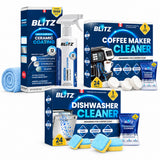
Washer and dishwasher in one box: the BLITZ Essentials Kit has 24 tablets of each, about a year of both at one every two weeks, for $43.95 ($4.95 less than buying them separately).
Slow drains and warning signs
One slow drain is usually a local clog: use a plunger or a drain snake, not a chemical opener (garburator sink? see disposal cleaner vs drain cleaner). These signs point to the system itself, according to Québec's ministry:
- A sewage smell near the septic system.
- Wastewater draining slowly out of the house.
- Grass over the system clearly greener or longer than the rest, or spongy even in a dry spell.
- Water coming up to the surface near the system.
- Bacteria or nitrates in your well water test, or your neighbour's.
Then call a professional such as an engineer or technologist. And fix a running toilet fast: Québec says it can use 10 to 20 times more water in a day than the whole house normally does.
Careful: Never go into a septic tank. It's a confined space with toxic gases and very little oxygen, which can quickly be fatal.
How often to pump a septic tank in Québec
Section 13 of the Regulation respecting waste water disposal systems for isolated dwellings (Q-2, r. 22) sets the minimum: a septic tank "that is used year-round must be pumped out at least once every 2 years," and one "that is used only seasonally must be pumped out at least once every 4 years." The ministry's FAQ defines seasonal as 180 days a year or less.
Only if your municipality provides a pumping service can the tank be pumped by measurement instead. In that case, it "must be pumped out when the thickness of the scum layer is equal to or greater than 12 cm or the thickness of the sludge layer is equal to or greater than 30 cm." Otherwise, you can't pick your own interval: the 2 and 4 years apply. Check your municipality's by-law and schedule.

A certified treatment system also needs a maintenance contract with at least one service a year, unless your municipality handles it.
Elsewhere in Canada
| Source | Pumping guidance |
|---|---|
| Ontario (SepticSmart, 2022) | Inspect every 3 to 5 years; clean out when a third of the tank's depth is sludge and scum |
| Nova Scotia | Every 3 to 5 years, depending on household size and care |
| Prince Edward Island | About every 3 years for an average tank |
Booking a cottage pump-out yourself? PEI's guide says not to pump a seasonal tank just before winter: an empty tank can be damaged by frost.

Are BLITZ products septic-safe?
Yes: every BLITZ product is septic-safe when used as directed. It's one tablet per clean, so a septic home gets the same small, steady dose every time.
- Toilet tablets with no bleach in the ingredients. BLITZ Automatic Toilet Bowl Cleaner goes in the tank, not the bowl, and lasts up to 30 days or 300 flushes; blue water shows it's working. 12 tablets, a year for one toilet: $25.95, about $2.16 a month ($25.95 ÷ 12). More in toilet tank tablets vs scrubbing.
- Mold Stain Remover is a bleach gel (sodium hypochlorite): treat it like any household bleach, in small amounts as directed, never with another cleaner.
- A Québec company in Laval, with service in French and English: free shipping from $40, most orders in 2 to 3 business days, 10% back in store credit, 30-day money-back guarantee (refund policy).

Rated 4.8 out of 5 (18 reviews) on goblitzclean.com
Frequently asked questions
Is bleach safe for a septic tank?
In moderate, measured amounts, yes, according to PEI and Nova Scotia. Never pour leftovers down a drain (Nova Scotia warns that flushing bleach can slow or stop treatment), and never mix bleach with another cleaner.
What cleaning products are safe for septic systems?
Ordinary household cleaners, dish soap and detergents at the label dose. Every BLITZ product is septic-safe when used as directed, at one tablet per clean.
Can you use drain cleaner with a septic tank?
Québec lists drain openers among products to keep out, and Nova Scotia says not to use them. Use a plunger or a drain snake, or call a plumber.
How often do you have to pump a septic tank in Québec?
At least every 2 years for a year-round home and every 4 years for seasonal use (section 13 of Regulation Q-2, r. 22). Where the municipality provides pumping, it may go by scum and sludge measurements instead.
Sources: Québec's environment ministry (owner's guide, septic FAQ, 2020 amendments FAQ, in French), Regulation Q-2, r. 22, Québec.ca, the RBQ, Ontario's SepticSmart, Nova Scotia's homeowner's guide and care sheet, PEI, Health Canada, and the BLITZ product pages, checked October 20, 2026. Your municipality may add its own rules. Prices on October 20, 2026; they can change.
NO BLEACH IN THE INGREDIENTS
BLITZ Automatic Toilet Bowl Cleaner
One tablet in the tank, not the bowl, cleans with every flush and helps keep a new ring from forming. Up to 30 days or 300 flushes per tablet: 12 tablets, a year for one toilet, $25.95. Septic-safe when used as directed.

Free shipping across Canada from $40, 10% back in store credit, 30-day money-back guarantee.


