



What Builds Up Inside Your Appliances, and How Often to Clean Each One
Studies find microbes where appliances hold water: NSF found yeast and mould in the coffee reservoir in half of the 22 homes it swabbed, and a 2011 study found fungi on the door seals of 62% of 189 home dishwashers. What you can see and fix is the buildup: detergent residue in the washer, food and grease in the dishwasher filter, scale in the coffee maker and countertop ice maker, food under the garburator's splash guard and a scale ring in the toilet. The BLITZ routine: one tablet every two weeks in the washer and dishwasher, twice a month in the coffee maker and garburator, every 1 to 2 months in the ice maker and monthly in the toilet tank, for buildup and odours.

Shop the BLITZ Whole Home Kit, $89.95
In this guide
A shiny door says nothing about the filter, seal or reservoir behind it. Here is the whole picture:

Why do appliance interiors need their own cleaning routine?
Because the inside is where water sits. Each of these appliances holds water, food, detergent or minerals in parts you never see: a rubber fold, a filter, a reservoir, a grinding chamber. Wiping the outside doesn't reach them.
What collects there:
- Residue: detergent and softener, food scraps, grease, coffee oils.
- Biofilm: the slimy film that forms where water stays and residue feeds it, as on rubber seals and reservoir walls.
- Scale: minerals from the water. The U.S. Geological Survey notes that hard water causes mineral buildup in plumbing, fixtures and coffee makers.
- Odour: usually the first sign of the other three.
Researchers find microbes in the same places. NSF International swabbed 30 items in 22 volunteer homes in Michigan (2011): the coffee maker's reservoir ranked fifth for germ count, with yeast and mould in half of the homes.
NSF's explanation: "Warm and moist environments are breeding grounds for germs." A University of Ljubljana team (Zalar et al., Fungal Biology, 2011) swabbed the rubber door seals of 189 home dishwashers in 101 towns: 62% were positive for fungi, and more than half of those held black yeasts (Exophiala). Swiss lab Empa sampled biofilm from 11 washing machines in four countries (Gattlen et al., Biofouling, 2010).
Those wet, hidden spots are also where residue, scale and odours build up. BLITZ tablets are cleaners for exactly that buildup, and the routine below targets what you can see and smell.
What builds up inside each appliance, and what to do
Use one product at a time: Health Canada warns never to mix bleach with other cleaning products.
Washing machine: drum, door seal and drawer
- What builds up: detergent and softener residue on the drum and outer tub. Samsung Canada says the rubber gasket can trap moisture, lint and detergent buildup.
- Signs: a musty smell, grey or black flecks on clean clothes, the cleaning reminder on the display.
- How often: at least monthly, say LG, Samsung and Whirlpool. LG's tCL reminder comes on after 30 washes.
- Fix: wipe the seal weekly, rinse the drawer and pump filter monthly (Samsung Canada), then one BLITZ Washing Machine Cleaner tablet in the empty drum, hottest cycle or Tub Clean, every two weeks.
Brand by brand reminders and loads per week: how often to clean your washing machine.
Dishwasher: filter, spray arms and door seal
- What builds up: food and grease in the filter and spray arm holes, a greasy film and scale on the tub floor, residue on the door seal.
- Signs: a smell when you open the door (Bosch traces it to food trapped in the filter), a white film on glasses with hard water.
- How often: Whirlpool says clean the filter at least once a month, every two weeks for large families, and use a dishwasher cleaner monthly.
- Fix: rinse the filter, clear the spray arm holes with a toothpick (Bosch's tip), wipe the seal, then one BLITZ Dishwasher Cleaner tablet in the detergent compartment, empty dishwasher, normal cycle, every two weeks.

Each smell and its cause: why your dishwasher smells bad.
Coffee maker: reservoir, lines and heater
- What builds up: mineral scale in the lines and heater, coffee oils on the basket or pod holder, and a reservoir that is rarely dry (the NSF finding above).
- Signs: slower brewing, a weaker or off taste, a descale light. Breville says scale reduces flow, temperature and taste.
- How often: Keurig says descale every 3 months or when the Descale light comes on (after 250 brews on the K-Express Essentials). Nespresso says every 3 months or 300 capsules for the Vertuo Next.
- Fix: wash the removable parts weekly. Then one BLITZ Coffee Maker Cleaner tablet in the water tank (drip or espresso) or pod holder (pod machines), a cycle without coffee, then a fresh-water rinse, twice a month.

One BLITZ tablet cleans and descales in the same cycle. More in coffee maker cleaning vs. descaling.
Countertop ice maker: reservoir, tray and sensors
- What builds up: scale on the tray, sensors and water lines, and a film in the reservoir, where water sits and melted ice flows back (GE says so for its Opal).
- Signs: white flakes in your drink (Whirlpool says they're minerals, usually calcium carbonate), cloudy or off-tasting ice, a Descale light.
- How often: NewAir and Igloo say change the water every 24 hours. The GE Profile Opal 2.0 lights Descale after 100 hours of ice making.
- Fix: drain, wash the basket, then one BLITZ Ice Machine Cleaner tablet in cool drinking water in the reservoir, and the cleaning mode twice. Drain, then run fresh water through before making ice. Every 1 to 2 months (monthly if it runs every day). Not for ice makers built into a fridge.

Model by model steps: how to clean an ice machine.
Garburator: splash guard and grinding chamber
- What builds up: food and grease in the grinding chamber and under the rubber splash guard. InSinkErator says food can accumulate under the baffle, and an odour is usually a sign of food buildup.
- Signs: a smell at the sink, a dark film under the splash guard.
- How often: one BLITZ Disposal Cleaner tablet twice a month (one or two for a 1/2 HP motor, two for 3/4 and 1 HP).
- Fix: power off, scrub under the splash guard, never a hand inside. Then a thin stream of hot water, the tablet, and run the unit while it foams. It doesn't clear a clogged drain or fix a jam.

Safe step by step: how to clean a garburator.
Toilet tank
- What builds up: mineral scale on the parts in the tank and a ring at the bowl's waterline, faster with hard water.
- Signs: a ring that comes back days after you scrub it.
- How often: one BLITZ Automatic Toilet Bowl Cleaner tablet in the tank (not the bowl) lasts up to 30 days or 300 flushes; when the blue water fades, add a new one. Scrub a heavy ring once first.
Fluidmaster, the flapper maker, warns against drop-in toilet bowl cleaners containing bleach or chlorine because they damage tank parts. BLITZ has no chlorine or bleach. Compare the options in toilet tank tablets vs scrubbing.
How often should you clean the inside of your appliances?
The makers' minimum is about once a month for most of them, and many machines count for you.

A family running 10 loads a week reaches LG's 30 washes in three weeks, and hard water or a musty smell calls for more. That is why the BLITZ rhythm in the chart at the top is every two weeks for the washer and dishwasher.
One routine for the whole home
Six schedules are hard to remember; two dates a month are not.

The chart above is the routine. On the 1st, about 20 minutes: a tablet in the washer, dishwasher, coffee maker and garburator, a new one in the toilet tank, and the filters. On the 15th, the four tablets again. The ice maker every other month, and the daily and weekly habits in between, like a dry washer seal and cold water after the garburator (15 seconds, says KitchenAid).
Tip: Set two repeating phone reminders, the 1st and the 15th, and keep the tablets together. Run the washer and dishwasher empty while the coffee maker's cycle runs.
What BLITZ covers, and what it costs
One tablet, one cycle. Prices on goblitzclean.com, checked October 19, 2026:
| Appliance | BLITZ product | Price and cost per use |
|---|---|---|
| Washer | Washing Machine Cleaner & Descaler, 24 tablets (4.9 out of 5, 14 reviews) | $24.95, about $1.04 a clean |
| Dishwasher | Dishwasher Cleaner & Deodorizer, 24 tablets (5.0 out of 5, 15 reviews) | $23.95, about $1.00 a clean |
| Coffee maker | Coffee Maker Cleaner, 24 tablets (4.8 out of 5, 14 reviews) | $24.95, about $1.04 a clean |
| Countertop ice maker | Ice Machine Cleaner, 24 tablets (4.9 out of 5, 13 reviews) | $24.95, about $1.04 a clean |
| Garburator | Disposal Cleaner & Deodorizer, 24 tablets (4.7 out of 5, 12 reviews) | $24.95, about $1.04 a clean |
| Toilet tank | Automatic Toilet Bowl Cleaner, 12 tablets (4.8 out of 5, 18 reviews) | $25.95, about $2.16 a month |
| Shop the Whole Home Kit |
The kits cost less than the same boxes bought separately:
- Essentials Kit, $43.95: washer and dishwasher, $4.95 less than buying both.
- Kitchen Kit, $69.95: dishwasher, coffee maker and Home Ceramic Coating, $17.94 less.
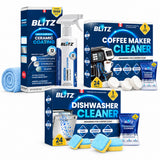
- Whole Home Kit, $89.95: washer, dishwasher, coffee maker and Home Ceramic Coating, $22.89 less.
All six interiors for a year: the Essentials Kit plus the coffee, garburator, ice machine and toilet boxes cost $144.75, about $12.06 a month (and the ice machine box lasts two years or more).
- A Québec company in Laval, service in French and English; every product is septic-safe.
- Free shipping in Canada from $40 ($7.95 under), most orders in 2 to 3 business days, 10% back in store credit on goblitzclean.com. Also on Amazon.ca.
- A 30-day money-back guarantee (refund policy).
Frequently asked questions
Do dirty appliances hold bacteria?
Some do. NSF found coliform bacteria in the coffee reservoir in 9% of the homes it swabbed, and yeast and mould in 50%; a 2011 study found fungi on the door seals of 62% of the dishwashers it sampled. A cleaning routine keeps those wet spots free of the residue, scale and buildup behind odours.
Does a cleaning tablet make an appliance germ-free?
BLITZ is a cleaner: one tablet breaks down the residue, scale and buildup behind odours inside the machine, the part you can see and smell. We make no germ claim.
How often should you clean the inside of appliances?
Most makers say at least monthly for the washer and dishwasher, and every 3 months to descale a Keurig or Nespresso. The BLITZ routine: the 1st and 15th for those and the garburator, monthly for the toilet tank.
Can I clean every appliance with vinegar?
Not safely in all of them. Whirlpool and Maytag advise against vinegar in the washer because its acidity can wear rubber parts, and LG Canada says excessive vinegar may damage a dishwasher. Never use vinegar and bleach together.
Sources: NSF 2011 Household Germ Study; Zalar et al., Fungal Biology 115(10), 2011; Gattlen et al., Biofouling 26(8), 2010; U.S. Geological Survey; Health Canada; makers' manuals and support pages (LG, Samsung, Whirlpool, Maytag, Bosch, Breville, Keurig, Nespresso, GE, NewAir, Igloo, KitchenAid, InSinkErator, Fluidmaster), checked October 19 and 20, 2026.
LG, Samsung, Whirlpool, Maytag, Bosch, Breville, Keurig, K-Express, Nespresso, Vertuo, GE, Opal, NewAir, Igloo, KitchenAid, InSinkErator and Fluidmaster are trademarks of their owners. BLITZ is not affiliated with them.
A YEAR OF INTERIOR CLEANING, FOUR APPLIANCES
BLITZ Whole Home Kit
Washing Machine Cleaner, Dishwasher Cleaner and Coffee Maker Cleaner (24 tablets each, about a year) plus Home Ceramic Coating for stainless and glass. $89.95, $22.89 less than buying them separately.

Garburator, ice maker or toilet too? Add the Disposal Cleaner, Ice Machine Cleaner or Toilet Bowl Cleaner.


