

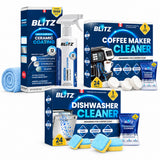


Coffee Maker Cleaning vs Descaling: What's the Difference?
Cleaning removes what the coffee leaves behind (oils, grounds and residue) from the parts it touches: basket, carafe, pod holder, brew head. Descaling removes what the water leaves behind (mineral scale) from the lines, pump and heater you can't reach. Rinse the parts daily, wash them weekly, and descale every 1 to 6 months depending on your water and your machine. BLITZ Coffee Maker Cleaner breaks down coffee oil residue and scale in the same cycle, for about $1.04 a clean.

Shop BLITZ Coffee Maker Cleaner, $24.95
In this guide
Cleaning vs descaling at a glance
Cleaning is about the coffee. Every brew leaves oils and fine grounds on the parts the coffee touches. Breville tells espresso owners to rinse the filter basket and portafilter under hot water right after use "to remove all residual coffee oils," and De'Longhi recommends rinsing its automatic machines before and after each use to avoid coffee buildup.
Descaling is about the water. Hard water carries dissolved calcium and magnesium, and heat makes them settle as scale on the heater and in the lines. Keurig explains that, depending on the mineral content of your water, calcium deposits or scale may build up and, left alone, hinder the brewer's performance. Breville says it reduces the brewing flow, the brewing temperature and the taste of the espresso.

The two jobs meet in one place: the inside of the machine, where coffee residue and scale build up together out of reach. A brush can't get there. Only something that runs through the water path can.
Which parts each one reaches
- The parts you can wash (cleaning): the carafe and its lid, the filter basket, a Keurig pod holder and funnel, a Nespresso capsule container and drip tray, an espresso portafilter and baskets, the steam wand. Warm, soapy water works for most. Some go on the top rack of the dishwasher (Cuisinart's carafe and basket), others are hand-wash only (Keurig's K-Express Essentials guide says its parts are not dishwasher safe).
- The parts you can't reach (descaling): the tank outlet, the pump, the heater and the tubing. Scale and old coffee residue build up there together, and only a solution in the water gets to them.
- In between: the needles of a pod machine. Keurig has you clear the entrance and exit needles with a straightened paper clip when grounds show up, then run two cleansing brews with no pod.

Tip: Don't dry the inside of the water tank with a cloth. Keurig and Cuisinart both warn that lint may stay behind. Rinse it and let it air-dry.
How often to clean and descale, by water hardness
How often you clean depends on how much coffee you brew. How often you descale depends on your water. Rinse the parts the coffee touches every day and wash them every week, whatever your water. Descaling is where your city matters: Cuisinart and De'Longhi both say the right frequency depends on the hardness of your water and how often you use the machine.
| Your water (USGS scale) | Examples from city water reports | Our suggested descaling |
|---|---|---|
|
Soft 0 to 60 mg/L |
Gatineau (32 to 45 mg/L, 2023 samples), most of Laval (about 50 mg/L, 2025) | The long end of your maker's range (Keurig: up to 6 months) |
|
Moderately hard 61 to 120 mg/L |
Montréal (117 mg/L average, 2024), Longueuil (113 to 117), Toronto (119), Sherbrooke (73) | About every 3 months, or when the light comes on |
|
Hard 121 to 180 mg/L |
Edmonton (173), Saskatoon (177), north Calgary (174) | Every 1 to 3 months |
|
Very hard over 180 mg/L |
South Calgary (224), Regina (203) | Monthly, and use a water filter if your machine takes one |
We built the last column from the makers' own ranges below. Check how hard the water is in your city.
The makers' own numbers for 1 to 2 cups a day: Keurig says every 3 months or when the Descale notification turns on (the K-Express Essentials reminds you every 250 brews; the K-Elite guide says 3 to 6 months, more often if calcium builds up faster). Nespresso says every 3 months or 300 capsules for the Vertuo Next. Hamilton Beach (with daily use) and Breville's Infuser instruction book say monthly.
With BLITZ, it's one schedule for both jobs: one tablet every two weeks at 1 to 2 cups a day takes care of the scale and the coffee oils inside. A box of 24 lasts a year, about $1.04 a clean.
Signs your coffee maker needs cleaning or descaling

- Grounds in your cup: cleaning. On a Keurig, clear the needles. Nespresso's Vertuo Next manual says to run its cleaning procedure twice.
- Slow brewing, partial cups, cooler or weaker coffee: usually scale, which lowers flow and brewing temperature (Breville). Keurig's fix for a partial cup: clear the exit needle, clean the pod holder, then descale.
- A white, chalky film in the tank: minerals from hard water. Descale, and descale more often.
- Stale or bitter taste: often both. Wash the parts, then run a cleaning cycle. If it's still bitter in a clean machine, look at the beans, the grind and the water: see why coffee suddenly tastes bitter.
What the descale light (and the "clean" light) means, brand by brand
A descale light is a reminder, not an alarm. Keurig's K-Express counts brews; De'Longhi sets its reminder from the water hardness you test and enter. The trap is the word "clean": a flashing Self Clean light on a Cuisinart drip machine means descale, while Breville's CLEAN ME light is about coffee oils.
| Brand | The light | What it means |
|---|---|---|
| Keurig | DESCALE | Descale. It stays on until the full procedure, fresh-water rinse included, is done |
| Nespresso Vertuo Next | Button blinks orange 3 times, then steady white | Descale (every 3 months or 300 capsules) |
| De'Longhi | Descale light | Descale, at a rate set from your water hardness test |
| Breville espresso | CLEAN ME | Coffee oils: a back-flush with the cleaning disc and a cleaning tablet, "separate from decalcifying" |
| Cuisinart Brew Central | Self Clean light flashes | Calcium buildup is affecting how it works and how the coffee tastes: descale |
| Hamilton Beach | A star on the clock display (models with a clock) | "The unit needs to be cleaned" with a decalcifier: descale |
For the step-by-step descale on your model, see how to descale a Keurig, how to descale a Nespresso Vertuo or how to remove limescale, brand by brand.
Daily and weekly habits that cut both jobs down

- Every brew: throw out the grounds, pod or capsule right away (Keurig says to always remove the used pod after brewing). Rinse the basket or portafilter. After steaming milk, purge the wand and wipe it.
- Every week: wash the carafe, basket, pod holder and funnel in warm, soapy water. Empty and rinse the tank and let it air-dry. On a De'Longhi automatic, take out the brew unit and rinse it with water only: De'Longhi says detergents will damage it.
- Every month on a Nespresso Vertuo Next: run its cleaning cycle with fresh water only (press the button 3 times within 2 seconds; it takes up to 7 minutes).
- Use good water, not distilled: Keurig suggests bottled or filtered water if you taste chlorine or minerals, but not distilled water, and Breville warns against demineralized or distilled water in its Dual Boiler.
- Change the water filter on time: Keurig every 2 months, Cuisinart every 60 days or 60 uses (sooner with hard water). Breville says a fresh filter reduces the need to decalcify, and De'Longhi says its filter widens the time between descaling. A filter spaces out descaling; it doesn't replace it.
One tablet for both jobs: where BLITZ fits
Makers split the two jobs: a descaling solution (or, on some drip makers, vinegar) for scale, then a water-only cleaning cycle or a back-flush for coffee oils. BLITZ Coffee Maker Cleaner breaks down mineral scale and coffee oil residue in the same cycle, so the inside of the machine gets both jobs at once. It works in single-serve pod machines (K-Cup brewers included), drip coffee makers and espresso machines.
- Drip or espresso machine: fill the water tank, drop in one tablet, then run a brew cycle without coffee, or your machine's descale or clean cycle (on a Cuisinart, that's Self Clean).
- Single-serve pod machine: put the tablet in the pod holder with no pod, pick the largest cup size and brew.
- Rinse: throw out the water, wipe off any loosened residue, then run one more full cycle with fresh water. Run another if the water still tastes of cleaner.
- Repeat every two weeks at 1 to 2 cups a day. For heavy scale, run a second cycle with a new tablet.

Get 24 tablets, about $1.04 a clean
Keep the weekly wash: the tablet works inside the machine, so the outside of the carafe, the drip tray, the capsule container and a milk wand still get soap and water. On a Breville, the CLEAN ME back-flush with its cleaning disc stays in the routine, and so does the water-only rinse of a De'Longhi brew unit.

Rated 4.8 out of 5 (14 reviews) on goblitzclean.com.
"I used them on my older Gaggia espresso machine, which had noticeable limescale, calcium buildup, and coffee oil residue that was affecting its performance. After following the cleaning process, the buildup was significantly reduced, and the machine was brewing much better."
Mohamed
- 24 tablets for $24.95, about $1.04 a clean and a year of cleanings at twice a month. One tablet, no vinegar smell. Comparing options? See descaler vs vinegar and our coffee maker cleaner tablets guide.
- Septic-safe, from BLITZ, a Québec company based in Laval, with service in French and English.
- Free shipping in Canada on orders of $40 or more ($7.95 under $40). Most orders arrive in 2 to 3 business days.
- 10% back in store credit on goblitzclean.com, and a 30-day money-back guarantee. Also on Amazon.ca (no store credit there).
Frequently asked questions
Is descaling the same as cleaning a coffee maker?
No. Cleaning removes coffee oils, grounds and residue from the parts the coffee touches. Descaling removes the mineral scale that hard water leaves inside the lines and heater. Most machines need both, on different schedules.
Should I clean or descale first?
Wash the removable parts first, put them back, then run the descale or cleaning cycle and the fresh-water rinse. That way the rinse runs through clean parts. With BLITZ, the tablet cycle handles the inside, so you only wash the parts by hand.
How often should you descale a coffee maker?
Every 1 to 6 months, depending on your water and how much you brew: Keurig and Nespresso say about every 3 months, Hamilton Beach monthly with daily use. Hard water means the short end of that range.
Does filtered water mean I never have to descale?
No. A filter spaces descaling out: Breville says a fresh filter reduces the need to decalcify, and De'Longhi says its filter widens the time between descaling. Don't switch to distilled water: Keurig advises against it.
Why is my descale light still on after I descaled?
On many machines the light only resets when you run the maker's full procedure, rinse included. Keurig says the full descaling procedure must be completed to turn off its Descale light. See how to descale a Keurig for each model.
What happens if you never descale?
Scale keeps building on the heater and in the lines: slower brewing, cooler and weaker coffee, then partial cups. Keurig says that, left alone, it can hinder the brewer's performance.
Can vinegar clean and descale at the same time?
Not really. Vinegar is an acid, so it works on scale, not on coffee oils, and the smell takes extra rinses. Breville's support page says not to use vinegar in its espresso machines. A BLITZ tablet does both jobs in one cycle, with no vinegar smell. The details are in coffee maker descaler vs vinegar.
Sources: Keurig K-Express Essentials and K-Elite use and care guides; Nespresso Vertuo Next user manual and descaling guide; De'Longhi Canada and De'Longhi support pages; Breville Infuser (BES840) and Dual Boiler (BES920) instruction books; Cuisinart Brew Central (DCC-1200C) instruction booklet; Hamilton Beach Canada FAQ; U.S. Geological Survey hardness scale; Gatineau, Laval, Montréal, Longueuil, Sherbrooke, Toronto, Edmonton, Saskatoon, Calgary and Regina water quality reports. Checked October 19, 2026.
Keurig, K-Cup, Nespresso, Vertuo, De'Longhi, Breville, Cuisinart, Hamilton Beach and Gaggia are trademarks of their owners. BLITZ is not affiliated with them.
CLEAN AND DESCALE IN ONE CYCLE
BLITZ Coffee Maker Cleaner
One tablet breaks down mineral scale and coffee oil residue in pod machines, including K-Cup brewers, drip and espresso machines. 24 tablets for $24.95, about a year at two cleanings a month.
Free shipping across Canada on orders of $40 or more, 10% back in store credit on every order, and a 30-day money-back guarantee.


