



How to Load a Dishwasher for Cleaner Dishes, Rack by Rack
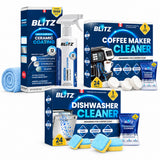
Scrape plates, but don't rinse them. Load plates on the bottom rack facing the centre, pots and bowls face down at the sides or back, and glasses, mugs and plastics on the top rack. Knives go handles up (every maker agrees); forks and spoons usually handles down, mixed, though GE says up. Before you press Start, spin the spray arms, check the detergent door can open and run the hot tap. To keep the machine itself clean, rinse the filter monthly and run one BLITZ tablet in the empty dishwasher every two weeks.

Shop BLITZ Dishwasher Cleaner, $23.95
In this guide
A dishwasher cleans by spraying hot water up from the arms under each rack. Anything that hides a dirty surface from that spray, or stops an arm from turning, comes out dirty. Every rule below comes from what Bosch, Whirlpool, GE, Samsung, LG and Frigidaire tell their own owners.
How to load a dishwasher, rack by rack

Bottom rack: plates, pots and big items
- Plates stand upright between the tines, dirty side toward the centre. Samsung and LG both say to face the centre. Some newer GE models don't need it.
- Pots, casseroles and bowls go face down, tilted. Bosch wants the insides of bowls, pots and pans facing the spray arms; Whirlpool says to angle them downwards "for maximum water flow."
- Big items go at the sides or back. Platters, baking sheets and large pots in front can block the detergent door and the spray (LG, GE and Frigidaire all warn about it).
- Nothing nests or overlaps. Bosch says to avoid nesting and contact points between dishes; LG says to avoid overlapping.
Top rack: glasses, mugs and plastics
- Glasses, cups and small bowls go upside down, tilted and spaced apart, so water drains off instead of pooling (Whirlpool, Bosch).
- Plastics go on the top rack, away from the heating element at the bottom. Whirlpool says dishwasher-safe plastics belong "on the upper rack only," and Frigidaire agrees. Bosch is the exception: its own page says plastics can go anywhere if they're labelled dishwasher-safe.
- Nothing pokes through the bottom of the rack. Bosch warns that a utensil hanging down can block the spray arm underneath.
Third rack: long utensils and cutlery
If you have one, use it. Bosch says its third rack holds knives, spatulas and other long tools lying flat; Whirlpool adds cutlery, coffee cups and small bowls, angled toward the spray.
Utensil basket: handles up or down?
Knives: handles up, every time. Bosch, Whirlpool, GE, Samsung and LG all say to load knives point down, so you never grab a blade when unloading. For forks and spoons, the makers disagree, as the table shows. Our suggestion: handles down so the eating ends get the full spray, and mix them so spoons don't nest (Samsung, Whirlpool and GE all warn about nesting).
| Maker | Knives | Forks | Spoons |
|---|---|---|---|
| Bosch | Handles up | Handles down | Handles down |
| Whirlpool, KitchenAid | Blades down (handles up) | Tines up, though another line on the same page says down | Alternate up and down |
| GE | Handles up | Handles up, to protect hands | Handles up (down for a very large load) |
| Samsung | Handles up | Handles down | Handles down |
| LG | Points down (handles up) | No rule given: use the slots so nothing nests | |
One more rule from GE and Frigidaire: don't mix sterling silver with stainless steel in the same basket, or the silver can be damaged.
Should you rinse dishes before the dishwasher?
No. Scrape them. Most makers say so plainly:
- Bosch Canada: "No pre-rinsing needed," just scrape food off the plate.
- Whirlpool says to skip pre-rinsing: the detergent is designed to work on food particles, and the sensors measure how dirty the load is to set the cycle.
- GE: scrape; the detergent is made to dissolve food residue.
- Frigidaire Canada: scrape large food particles to keep them out of the filter, "but there's no need to take it any further."
- Samsung asks you to remove bones, seeds, toothpicks and paper.
The exceptions. Bosch says to pre-treat burned-on, baked-on or starchy food. LG goes further: its troubleshooting page says to rinse dishes before loading, and to soak burnt pots for an hour, then pre-rinse. If the load won't run right away, Frigidaire suggests the Rinse cycle so food doesn't harden.
Tip: Scraping matters more than rinsing because everything you leave on the plate ends up in the filter. Bones, seeds and labels are what clog it and start the smell. Our dishwasher smell guide covers the filter, spray arms and door seal step by step.

Four checks before you press Start

- Spin the spray arms by hand. Samsung says to spin them manually to make sure nothing blocks them, and to move pot handles that get in the way. Bosch and LG both say the arms must rotate freely.
- Make sure the detergent door can open. A cutting board or tall platter standing in front of it keeps the detergent locked in until the end of the cycle. GE, LG and Frigidaire all list this.
- Run the hot tap at the sink until it's hot. Whirlpool, GE and Bosch all say so. Whirlpool says its dishwashers work best with water coming in at about 49°C (120°F), and GE says 49 to 60°C (120 to 140°F) is usually needed to dissolve fats.
- Keep the rinse aid filled. Bosch says to always use liquid rinse aid for proper drying, even if your detergent contains some, and Frigidaire Canada says it helps cleaning, not just drying. A full dispenser lasts about a month (GE, Whirlpool). For cloudy glasses, see white film on dishes.
And don't overload. Whirlpool says overloading "can lead to inadequate water circulation," and Frigidaire puts it plainly: don't stack dirty dishes and expect them to come out clean.
What should never go in the dishwasher
When an item has no dishwasher-safe mark, wash it by hand. These are the ones the makers name:
| Item | What the maker says |
|---|---|
| Cast iron | Lodge: in the dishwasher, it might rust. Bosch and GE: "Iron will rust." |
| Wood (boards, spoons, handles) | Bosch: can crack, warp and lose its finish. John Boos: never put its cutting boards in the dishwasher. |
| Good kitchen knives | Wüsthof: never in the dishwasher, because the heat and knives rubbing together can damage them. |
| Crystal, gold- or silver-trimmed and antique china | Samsung Canada: hand-wash china with gold or silver trim or hand painting; china over 15 to 20 years old isn't made for the heat. LG: crystal can turn cloudy. |
| Non-stick pans | T-fal Canada says its non-stick is dishwasher-safe but still recommends hand washing. Check the bottom of your pan. |
| Insulated mugs and bottles | Thermos: most are top-rack dishwasher-safe, but it recommends hand washing and points to each product's care sheet. |
| Copper, pewter, brass, bronze, tin | Bosch: pewter, brass and bronze tarnish. GE: pewter and tin are not safe. Whirlpool: copper can be damaged or lose its finish. |
| Plastics not marked dishwasher-safe | Whirlpool: items not labelled dishwasher-safe may break; even safe plastics go on the upper rack only. |
Dishes still dirty? Clean the filter and the machine
Perfect loading can't make up for a clogged filter or spray holes crusted with scale. Gritty bits, a greasy film or a smell all point to the dishwasher itself.

- Rinse the filter about once a month. Whirlpool and GE say monthly, every two weeks for a big family (Whirlpool); a Bosch manual says 3 to 6 times a year for light use, 8 to 12 for heavy use.
- Clean the inside of the machine. Whirlpool says to run a dishwasher cleaner every 30 days, and Bosch every 1 to 2 months. With BLITZ it's one tablet in the detergent compartment of the empty dishwasher and a normal cycle, every two weeks. It breaks down grease, grime and limescale on the walls, racks and spray arms, where loading can't help.
| How often | What to do |
|---|---|
| Every load | Scrape, load by the rules above, spin the arms, run the hot tap |
| Every two weeks | One BLITZ tablet, empty dishwasher, normal cycle24 tablets, $23.95 |
| Every month | Rinse the filter, refill the rinse aid, check the spray arm holes |
Why BLITZ for the machine
Loading takes care of the dishes; BLITZ takes care of the dishwasher.

- One tablet, for any household dishwasher, stainless or plastic tub, with a light lemon scent.
- A year in one box: 24 tablets for $23.95, about $1.00 a clean at one every two weeks.
- Septic-safe, and rated 5.0 out of 5 (15 reviews) on goblitzclean.com.
- A Québec company based in Laval, with service in French and English. Free shipping in Canada from $40 ($7.95 below), most orders in 2 to 3 business days, 10% back in store credit and a 30-day money-back guarantee. Also on Amazon.ca.
Comparing brands first? Our best dishwasher cleaner in Canada roundup lists prices and cost per clean.
Frequently asked questions
Should forks go up or down in the dishwasher?
Makers disagree. Bosch and Samsung say handles down, so the tines get the full spray; GE says handles up, to protect your hands; Whirlpool's page says both. Knives always go handles up, and mixing forks and spoons keeps them from nesting.
Do you need to rinse dishes before putting them in the dishwasher?
Usually not. Bosch, Whirlpool, GE and Frigidaire say to scrape food off and skip the rinse; LG is the exception and says to rinse. Pre-treat burned-on pans, and run a Rinse cycle if the load will wait.
Do pots go on the top or bottom rack?
The bottom rack, face down and tilted, at the sides or back so they don't block the spray or the detergent door. GE also lets small saucepans and mixing bowls go face down on top.
Can plastic go on the bottom rack?
Whirlpool, Frigidaire and some Samsung models say top rack only, away from the heating element. Bosch says anywhere, as long as it's marked dishwasher-safe.
Why are my dishes still dirty after the dishwasher?
Usually a blocked spray arm, a detergent door that couldn't open, lukewarm water or a clogged filter. Fix the load first, then clean the filter and run a cleaning cycle in the empty dishwasher.
Can cast iron go in the dishwasher?
No. Lodge says a dishwasher can make cast iron rust, and Bosch and GE say the same of iron. Wash it by hand, dry it and oil it lightly.
Sources: Bosch, Whirlpool, KitchenAid, GE Appliances, Samsung, LG and Frigidaire loading guides, support pages and manuals; Lodge, John Boos, Wüsthof, T-fal and Thermos care pages, checked October 20, 2026. Brand names are trademarks of their owners; BLITZ is not affiliated with them.
CLEAN DISHES START WITH A CLEAN MACHINE
BLITZ Dishwasher Cleaner & Deodorizer
One tablet in the detergent compartment of the empty dishwasher breaks down grease, grime and limescale buildup, with a light lemon scent. 24 tablets for $23.95, a year at one clean every two weeks. Rated 5.0 out of 5 (15 reviews).
Free shipping across Canada on orders of $40 or more, 10% back in store credit, and a 30-day money-back guarantee.

Cleaning the washer too? The Essentials Kit (24 washer + 24 dishwasher tablets) is $43.95, $4.95 less than buying both.


