






Baking Soda and Vinegar for Cleaning: What the Fizz Does, and When to Use Each
Baking soda and vinegar don't clean better together. Vinegar is an acid and baking soda is a base, so mixed they mostly cancel out: the fizz is carbon dioxide, and what's left is water and sodium acetate, which chemist Nathan Kilah notes is an even weaker cleaner than baking soda. Use them one at a time: vinegar to dissolve white hard-water scale, a baking soda paste to scrub grime. Inside the dishwasher, washer or garburator, neither lifts the grease that causes most smells: there, we pick BLITZ, one tablet per clean for grease and scale, about $1.25. Never mix vinegar with bleach.
What do you see?
More on this ↓Your fix
See product details & reviews- 30-day money-back guarantee
- Free shipping from $40
- A Laval, Québec company
Your fix
- 1 tablet in the empty drum, hottest cycle
- Every 2 weeks: 24 tablets last a year
- Front-load, top-load and HE
- 30-day money-back guarantee
- Free shipping from $40
- A Laval, Québec company

Your fix

- 1 tablet, twice a month
- Foams through the whole grinding chamber
- Light citrus scent
- 30-day money-back guarantee
- Free shipping from $40
- A Laval, Québec company


Shop BLITZ Dishwasher Cleaner, $29.95
In this guide: 9 sections
What happens when you mix them
The fizz is a chemical reaction using up both ingredients. White vinegar is a dilute acid (acetic acid; Canadian vinegar is 4.1 to 12.3%), and baking soda (sodium bicarbonate) is a mild base. When they meet:
vinegar + baking soda → water + carbon dioxide (the bubbles) + sodium acetate
Nathan Kilah, a senior lecturer in chemistry at the University of Tasmania, explains in The Conversation that sodium acetate is an even weaker base than baking soda, so it adds little cleaning power. In most recipes one ingredient is in excess: he calculates that over 99% of the baking soda is still there after the fizz stops, so whatever cleaning happens is the leftover baking soda, not the mix. His advice: use either vinegar or baking soda by itself, depending on what you're cleaning.
5 myths, checked


Where vinegar alone works
Vinegar dissolves mineral scale: the white crust hard water leaves behind is mostly calcium carbonate, and any acid breaks it down. That makes plain white vinegar (or citric acid, which has no smell) good for:
- Kettles: Rowenta's manual uses half a litre of vinegar for an hour, unheated. Steps: how to descale a kettle.
- Shower heads: Delta's method is a 30-minute soak in half vinegar, half water: how to clean a shower head.
- Glass and taps: white spots on shower glass and around faucets. Keep it off natural stone and rinse metal finishes.
Vinegar doesn't cut grease or food film: those need a detergent. Citric acid against vinegar, appliance by appliance: citric acid or vinegar.

Citric acid: vinegar's job without the smell
If you use vinegar for scale, citric acid does the same work with no smell to rinse out. It's the acid in lemons, sold as a powder in grocery and bulk stores. Rowenta's kettle manual uses 25 g in half a litre of just-boiled water for 15 minutes, and LG names it its first choice for descaling a dishwasher, ahead of vinegar. Like vinegar, it dissolves scale, not grease, and it reacts with baking soda the same way, so don't mix them either.
Where baking soda alone works
Baking soda is a mild abrasive and a weak base. On its own it's useful as:
- A scrub paste: a few spoonfuls with a little water for stuck-on grime on sinks, pots, oven doors and stovetop drip pans. Rinse well; it leaves a white film if you don't.
- An odour absorber: an open box in the fridge.
- A garburator rinse: InSinkErator's own care manual uses half a sink of warm water with a quarter cup of baking soda, then runs the disposer as the stopper comes out, to wash away loose particles.
It doesn't dissolve hard-water scale (it's alkaline, not acidic), so it won't descale a kettle or a coffee maker.
Baking soda and vinegar for drains
This is the one place the fizz can do something: Kilah notes the bubbling may have a mechanical effect in a blocked drain. In practice that means a slow kitchen or bathroom sink with a light film, not a real clog.
The usual recipe, the one GE Appliances gives for garburators:
- Pour half a cup of baking soda into the drain, then a cup of white vinegar, and cover the drain.
- Wait 10 to 15 minutes, then flush with a kettle of hot water (not boiling into a plastic trap).
- Real clogs of grease, hair or food need a plunger, then the trap opened or a snake. If those don't work, call a plumber.
- Never after a chemical drain cleaner: if you've already poured one in, don't add vinegar on top.
- Smelly but draining? The source is usually the garburator or a dry trap, not the pipe: kitchen sink smells.
In the dishwasher, washer, garburator and coffee maker
Most appliance smells and buildup come from grease, detergent film and food residue, which neither vinegar nor baking soda removes well, and some makers limit vinegar.
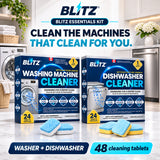
- Dishwasher: Whirlpool, KitchenAid and Maytag say using vinegar too often could damage the dishwasher. The baking soda sprinkled on the floor in many recipes just cancels the vinegar out. What makers say and how to do it once in a while: how to clean a dishwasher with vinegar. For the routine clean, one BLITZ Dishwasher Cleaner tablet in the empty machine on a normal cycle removes grease, grime and limescale, about $1.25 a clean.
- Washing machine: makers differ on vinegar, and the residue that smells is detergent film and grime on the drum and outer tub: washing machine cleaner vs vinegar. One BLITZ Washing Machine Cleaner tablet on the hottest cycle breaks down detergent residue, grime and mineral deposits.
- Garburator: the baking soda and vinegar recipe is mostly fizz in there too: what actually cleans a garburator. A BLITZ Disposal Cleaner tablet foams through the grinding chamber with the water running.
- Coffee maker: baking soda doesn't descale, and Keurig, Nespresso, De'Longhi and Breville espresso machines say no vinegar: coffee maker descaler vs vinegar.
Dishwasher tablets: 24 for $29.95
What never to mix
- Vinegar and bleach: Health Canada warns that bleach mixed with acids, vinegar included, releases toxic chlorine gas. Never in the same bucket, drain or cycle. What to do if it happens: can you mix bleach and vinegar?
- Bleach and ammonia: also toxic gases, Health Canada says.
- Vinegar in a closed bottle with baking soda: the carbon dioxide builds pressure and can pop the cap. Don't pre-mix them in a spray bottle.
One product at a time, rinsed between, and read the label first.

Frequently asked questions
Do baking soda and vinegar clean better together?
No. They neutralize each other into water, carbon dioxide and sodium acetate, a weak cleaner. Use vinegar alone for scale and baking soda alone as a scrub.
Do baking soda and vinegar unclog drains?
The bubbling may nudge a minor sink clog. A real clog of grease, hair or food needs a plunger, the trap opened or a snake, then a plumber.
Can I put baking soda and vinegar in my washing machine?
Together they mostly cancel out, and neither lifts the detergent residue that causes washer smells. We pick one BLITZ washer tablet on the hottest cycle instead: residue, smell and scale in one cycle, about $1.25.
Can I use baking soda and vinegar in the dishwasher?
Whirlpool, KitchenAid and Maytag say frequent vinegar could damage the dishwasher, and baking soda cancels it out. Use vinegar alone now and then, and a dishwasher cleaner for grease.
What does vinegar clean best?
White hard-water scale: kettles, shower heads, glass, taps. It doesn't cut grease.
Is it safe to mix baking soda and vinegar?
Yes, in an open container: it only makes carbon dioxide and a salt. Don't seal it in a bottle, and never add bleach to vinegar.
Do lemon juice and baking soda clean better together?
Same chemistry: lemon juice is an acid, so it neutralizes the baking soda just like vinegar. Use lemon juice alone on light scale and baking soda alone as a scrub.
What should I use instead to clean a smelly dishwasher or washer?
A cleaner made for the machine, run empty: it removes the grease and detergent residue that cause the smell, which neither vinegar nor baking soda does well.
Sources
Nathan Kilah, University of Tasmania, Cleaning with vinegar and baking soda: is it a hack or just a bunch of fizz? (The Conversation, republished by SBS News, March 2024); Food and Drug Regulations (Canada) on vinegar acetic acid content; InSinkErator care manual (baking soda rinse); Whirlpool, KitchenAid and Maytag dishwasher guidance on vinegar; Rowenta kettle manual; Delta Faucet shower head guide; Health Canada on mixing bleach; BLITZ product pages. Checked October 29, 2026.
InSinkErator, Whirlpool, KitchenAid, Maytag, Rowenta, Delta, Keurig, Nespresso, De'Longhi and Breville are trademarks of their owners. BLITZ is not affiliated with them.
WHAT VINEGAR AND BAKING SODA LEAVE BEHIND
BLITZ Dishwasher Cleaner & Deodorizer
One lemon-scented tablet in the detergent compartment of the empty dishwasher, a normal cycle: it removes the grease, grime and limescale that vinegar and baking soda leave behind. 24 tablets, a year at one every two weeks, $29.95, or three boxes for $59.90 with Buy 2, Get 1 Free. Septic-safe.
Free shipping across Canada on orders of $40 or more, 10% back in store credit, and a 30-day money-back guarantee.

Smelly washer instead? BLITZ Washing Machine Cleaner, one tablet on the hottest cycle, $29.95 for 24.


