



Citric Acid vs Vinegar for Cleaning Appliances: The Chemistry and What Makers Say
Citric acid: it's the stronger acid, it has no smell, and it binds the calcium it dissolves. BLITZ tablets (washer, dishwasher, coffee maker) give you citric acid in one tablet. Dishwasher: citric acid (LG says 40 g "for best results"; GE uses it when vinegar fails), or one BLITZ dishwasher tablet. Washer: skip vinegar (Whirlpool, Maytag and Bosch say it wears rubber seals); one BLITZ washer tablet in the empty drum, then a hot cycle. Keurig and espresso machines: no vinegar (Keurig, Nespresso, De'Longhi, Breville); a BLITZ coffee maker tablet is a citric acid descaler, the same acid as Keurig's own solution. Drip coffee maker: one BLITZ tablet in the water tank, a cycle without coffee, then a fresh-water rinse: no vinegar smell or taste. Never mix either acid with bleach.

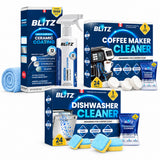
Shop the BLITZ Whole Home Kit, $89.95
In this guide
Citric acid vs vinegar at a glance
Both dissolve the white crust hard water leaves, and neither removes grease. What separates them: strength, smell, and how much you have to measure.

How an acid dissolves limescale (the chemistry in plain words)
Limescale is mostly calcium carbonate, the mineral in chalk. The USGS explains that hardness comes from calcium and magnesium, and that solid calcium carbonate deposits form when hard water is heated, as in a water heater. Any appliance that heats water scales.
Any acid takes it apart. The acid releases hydrogen ions that break up the carbonate into carbon dioxide (the fizz you see on a scaled kettle element) and water. The calcium ends up dissolved in the water, and the rinse carries it away.

Citric acid is the stronger of the two. PubChem lists a first pKa of 2.79 for citric acid and 4.76 for acetic acid, the acid in vinegar (the lower the number, the stronger the acid). Citric acid also has three acid groups per molecule to acetic acid's one, and citrate binds calcium ions: chemists call it a chelating agent.
Dose matters as much as the acid. In Canada, vinegar must contain 4.1 to 12.3% acetic acid (Food and Drug Regulations, B.19.001), and the label shows the percentage. Citric acid powder is pure acid, so its strength is whatever you measure: on paper, LG's 40 g carries about as much acid as 700 mL of 5% vinegar, two to three times LG's own vinegar fallback (our calculation, counting all three acid groups).
Neither acid lifts grease, coffee oils or food residue. Those need a surfactant or a detergent. For scale across the house, see hard-water buildup in appliances.
Why vinegar smells and citric acid doesn't
Acetic acid evaporates easily. PubChem gives its vapour pressure as about 15.7 mm Hg at 25°C, and it climbs as the water heats, which is why a hot vinegar cycle fills the kitchen. Citric acid is an odourless crystalline solid that doesn't evaporate, so it does the same descaling job without the smell.
The smell matters most in a coffee maker. De'Longhi says vinegar "is prone to leave a strong smell and an acid taste" in your coffee, and Nespresso notes that its descaling kit, unlike vinegar, has no unpleasant odour. A strong smell isn't a better clean: it's the acid leaving the water.

What each does to rubber seals and metal
Over many cycles, vinegar can also work on rubber, metal and finishes:
- Washer seals and hoses: Whirlpool says vinegar's acidity can damage washer components over time, "particularly rubber seals and hoses." Maytag says the same of rubber parts, and Bosch says vinegar may degrade them.
- Dishwashers: Whirlpool, KitchenAid and Maytag say vinegar is an acid and using it too often could damage the dishwasher. Miele says acidic substances such as vinegar can lead to rust and leaks in its dishwashers.
- Stainless steel: a GE dishwasher guide warns that vinegar and lemon juice left on stainless flatware can discolour it, and has you remove metal utensils before its acid rinse.
- Stone counters: marble and limestone are calcium carbonate, the same mineral as scale, so any acid etches them. Consumer Reports warns vinegar etches and dulls them. Wipe up citric acid spills just as fast.
Where a tablet fits: the rubber warnings above are about vinegar. One BLITZ tablet holds the citric acid for one cycle: no long soak, and the machine rinses it out.
What appliance makers say about vinegar and citric acid
| Appliance | Vinegar | Citric acid or other descalers |
|---|---|---|
| Whirlpool, Maytag washers | Not in the drum (wears rubber seals and hoses) | Not named; a cleaner tablet instead |
| Whirlpool, KitchenAid, Maytag dishwashers | Now and then; "too often could damage" | Not named |
| Samsung washers | 4 cups for hard water | Self Clean: bleach only, no other chemicals |
| LG washers | 200 mL (3/4 cup) in the detergent cup | Cleaning tablets in the tub |
| LG dishwashers | 200 to 300 mL, if no citric acid | "For best results," 3 tbsp (40 g) citric acid |
| GE washers | 1 cup (250 mL) in Basket Clean | Not named |
| GE dishwashers (older guide) | 2 cups (500 mL) for film | 1/4 cup (60 mL) citric acid if vinegar fails |
| Keurig | No; acidity "not always standardized" | A descaler; Keurig's own uses citric acid |
| Nespresso | "Never use vinegar" | A descaling kit |
| De'Longhi | "Never vinegar" | A descaler (De'Longhi's is lactic acid) |
| Breville espresso | "Do not use vinegar" | A descaler made for the machine |
| Shop BLITZ tablets |
The pattern: LG and GE, the dishwasher makers that name an acid for scale, prefer citric acid to vinegar. Keurig, Nespresso, De'Longhi and Breville all say no vinegar in their coffee machines, and Keurig's own descaler is citric acid, the same acid as a BLITZ coffee maker tablet.
Brand-by-brand detail: coffee maker descaler vs vinegar and washing machine cleaner vs vinegar.
How much citric acid to use: the doses makers give
Only two of the makers we checked give a citric acid dose, and both are for dishwashers:
- LG dishwashers (about 2 minutes, then one cycle). Take out the dishes and silverware basket, leaving only the racks. Fill the main detergent compartment with 3 tablespoons (40 g) of citric acid powder (LG says grocery stores carry it with canning supplies). Run Machine Clean with no detergent.
- GE dishwashers, for spots and film on glassware (one heavy cycle). Remove metal utensils, add no detergent and start the heaviest cycle (Potscrubber). After 18 to 22 minutes, open the door and pour 2 cups (500 mL) of white vinegar into the bottom. If that doesn't clear the film, repeat with 1/4 cup (60 mL) of citric acid crystals instead. If neither works, GE says the cloudiness is etching, which can't be removed. Needing this more than twice a month? GE suggests a water softener.
For washers and coffee makers, use one tablet. No washer or coffee maker brand we checked gives a citric acid dose, so use one BLITZ tablet per cleaning: it holds the full dose for one cycle. For kettles, KitchenAid recommends a commercial descaler and gives a vinegar method only if you have none. For film on glasses, see white film on dishes.
Careful: Citric acid powder can seriously irritate the eyes (it carries the GHS hazard H319 in most European notifications, per PubChem). Pour it slowly and keep it away from your eyes and from children.
BLITZ dishwasher tablets: 24 for $23.95, $1.00 a clean
Never mix citric acid or vinegar with bleach
Health Canada is blunt: "Bleach will react with any cleaning product containing ammonia or an acid, including vinegar." The gases can burn your eyes and "can also be deadly." With an acid, the gas is chlorine: the US CDC notes that bleach mixed with vinegar can generate chlorine gas that damages the lungs. Citric acid is an acid too: coming from lemons doesn't make it safe to mix.
- One product per cycle. Samsung's Self Clean takes bleach and no other chemicals, so never add vinegar or citric acid to it.
- Rinse between products. Our suggestion: after a bleach cycle, run a plain-water rinse before any acid goes in.
- Skip vinegar plus baking soda. They neutralize each other. More in vinegar or bleach for a washing machine.

Citric acid tablets vs a bag of powder
A bag of citric acid leaves the dose to you, puts powder near your eyes, and does nothing for grease. A tablet settles the first two, and the washer and coffee maker tablets add a surfactant for the third.
- One tablet per cleaning. No powder to pour near your eyes.
- Citric acid, listed on the product page. The washer, dishwasher, coffee maker and ice machine tablets all list citric acid, and none lists vinegar. The washer and coffee tablets add a surfactant (sodium C14-16 olefin sulfonate, sodium lauryl glutamate) for the oils an acid leaves behind.
- No vinegar smell. The washer tablet is unscented; the dishwasher tablet has a light lemon scent.
- About $1 a cleaning, a year in a box. Washer and coffee maker tablets are $24.95 for 24 (about $1.04 each), dishwasher tablets $23.95 (about $1.00). The Whole Home Kit ($89.95) bundles all three with the ceramic coating, $22.89 less than separately.
- Rated 4.8 to 5.0 out of 5 on goblitzclean.com (washer 4.9 out of 5 (14 reviews), dishwasher 5.0 out of 5 (15 reviews), coffee maker 4.8 out of 5 (14 reviews)). Septic-safe.
- A Québec company in Laval, with service in French and English: free shipping from $40 ($7.95 under), most orders in 2 to 3 business days, 10% back in store credit, a 30-day money-back guarantee. Also on Amazon.ca.

Frequently asked questions
Is citric acid better than vinegar for descaling?
For limescale, yes: it's stronger, binds calcium and has no smell, and LG says it gives the best results in its dishwashers. One BLITZ tablet holds the citric acid for one clean, at about $1.
Can I use citric acid instead of vinegar in my coffee maker?
Yes: one citric acid tablet per descale. Keurig, Nespresso, De'Longhi and Breville all say no vinegar, and Keurig's own descaler is citric acid. One BLITZ Coffee Maker Cleaner tablet goes in the water tank (drip or espresso) or the pod holder (pod machines), then a cycle without coffee and a fresh-water rinse. More in coffee maker descaler vs vinegar.
How much citric acid do I use to clean a dishwasher?
LG says 3 tablespoons (40 g) in the main detergent compartment, then Machine Clean with no detergent. For film on glassware, a GE guide uses 1/4 cup (60 mL) of crystals, added to the bottom about 20 minutes into the heaviest cycle, with metal utensils removed.
Does vinegar damage rubber seals?
Over time, say Whirlpool, Maytag and Bosch, and Consumer Reports says front loaders are most at risk. A BLITZ washer tablet skips the vinegar: one tablet in the empty drum, then a hot cycle.
Can I mix citric acid with bleach?
No. Health Canada warns that bleach reacts with any acid, including vinegar, and can release toxic gases. Citric acid is an acid: one product at a time.
Sources: the appliance makers' manuals and support pages named above, Consumer Reports, Health Canada, the US CDC, Canada's Food and Drug Regulations, the USGS and PubChem, checked October 20, 2026. Brand names are trademarks of their owners; BLITZ is not affiliated with them.
24 TABLETS PER APPLIANCE, ABOUT $1 A CLEAN
BLITZ Whole Home Kit
Washer, dishwasher and coffee maker tablets (24 of each) plus the ceramic coating spray. One tablet per cleaning, about $1 a clean. $89.95, $22.89 less than separately.

Just one appliance? Get the coffee maker, washer or dishwasher tablets on their own.


