



A Practical Cleaning Routine for Canadian Homes: Daily, Weekly, Monthly and Seasonal
A practical routine for a Canadian home has four layers: 10 minutes a day (kitchen, entrance, bathroom moisture), one weekly round room by room, appliance interiors every two weeks to monthly, and a short seasonal list. Then adjust for the climate: road salt at the door, indoor humidity between 30% and 50% (Health Canada; lower in deep cold), hard water and septic tanks. BLITZ turns the appliance part into one tablet every two weeks. No government sets an official household cleaning standard: this routine is ours, built from public guidance and makers' manuals.

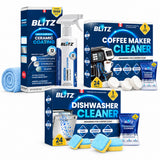
Shop the BLITZ Whole Home Kit, $89.95
In this guide
Your cleaning routine at a glance
We found no federal or provincial household cleaning standard in Canada, so this routine puts what does exist on one page: Health Canada and CMHC advice on humidity and mould, CMHC's Home Maintenance Schedule (2010) and each appliance maker's manual.

Print it and tape it inside a cupboard door.
Daily: the 10-minute reset
Our 10-minute reset after supper (the times are our estimates), which keeps the weekly round to about an hour:
- Kitchen, 4 minutes. Wipe the counters, stovetop and sink, run or empty the dishwasher, take out food scraps.
- Entrance, 2 minutes. Boots on a tray, mitts and toques to dry, and wipe slush puddles before the salt dries into white marks.
- Bathroom, 2 minutes. Leave the fan running at least 30 minutes after a shower or bath, as Health Canada advises, and squeegee the shower walls.
- Laundry, 1 minute. Take wet laundry out as soon as the cycle ends, and leave the washer door and detergent drawer open to dry.
- One last look, 1 minute. Wet window sills or a soaked mat? Dry them: Health Canada says mould can start within 48 hours where moisture stays.
Weekly: one round, room by room
Pick one day. Start at the entrance so you don't carry grit through the house.

Three appliance jobs also belong to the weekly round:
- Washer door seal: Samsung Canada says to wipe it weekly. Pull back the fold, wipe and dry.
- Garburator splash guard: our suggestion is a weekly scrub of the underside with dish soap, power off. InSinkErator says odour usually means food buildup.
- Dishwasher: GE says running it at least once a week can usually prevent odours.
Monthly: appliance interiors
An appliance rarely looks dirty inside until it smells or leaves residue. Here is what each maker asks for and the BLITZ routine that covers it. The why is in why appliance interiors need their own cleaning routine.
| Appliance | What the makers say | Our routine |
|---|---|---|
| Washing machine | Drum at least monthly, or at the reminder (LG: 30 washes; Samsung: 20 or 40 cycles) | One BLITZ tablet in the empty drum every two weeks |
| Dishwasher | Whirlpool: filter at least monthly, every two weeks for large families. GE: monthly to every other month | Rinse the filter; one tablet every two weeks |
| Coffee maker | Keurig: descale every 3 to 6 months. Nespresso: every 3 months or 300 capsules | One tablet twice a month: it cleans and descales in the same cycle |
| Countertop ice maker | NewAir, Igloo: fresh water every 24 hours. Silonn, Frigidaire: weekly clean | One ice machine tablet every 1 to 2 months (monthly if it runs daily) |
| Garburator | InSinkErator: run cold water while grinding; odour means food buildup | One disposal tablet twice a month |
| Range hood | CMHC (2010 schedule): check and clean the filters monthly | Metal mesh filter in hot, soapy water |
| Shop the Whole Home Kit |
Every two weeks rather than monthly is our advice: busy homes hit the load reminder early, and hard water builds scale faster. Washer details: how often you should clean your washing machine.

Tip: Put the 1st and the 15th on your phone calendar as tablet days: washer, dishwasher and coffee maker. Two dates a month cover all three.
Seasonal: what a Canadian year asks for
CMHC's Home Maintenance Schedule (2010, now in CMHC's archive) names no months, since seasons vary by region and year. Here is its cleaning side, checked against current Health Canada, NRCan and CMHC pages.

- Fall: furnace service (CMHC: every two years for gas, yearly for oil), HRV filters and core if it was off all summer, the portable humidifier, and a check that the bathroom fan and range hood still pull air. Back-to-school week is a good moment: see our back-to-school home reset.
- Winter: furnace filter checked monthly (CMHC, 2010; Natural Resources Canada says change or clean it every 3 months or when dirty), HRV filters every two months (CMHC's HRV page), outside vents and the dryer hood clear of snow, the bathroom fan grille vacuumed.
- Spring: salt marks, screens, the dryer duct. Our spring cleaning checklist takes it room by room.
- Summer: basement under 60% humidity with a dehumidifier (CMHC), A/C filter, and the countertop ice maker cleaned before patio season.
Winter: road salt and slush at the entrance
The entrance takes the worst of winter: slush, gravel and road salt. Stop it at the door instead of chasing it through the house.
- Two mats. Hardwood maker Mirage recommends mats outside and inside entrances, and no rubber or dense backing, which traps grit and moisture.
- A boot tray for meltwater, rinsed weekly.
- Vacuum, then damp-mop. Grit first, or the mop drags it across the finish. For white salt marks, our method: warm water with a little mild soap, a clean-water rinse, then dry, unless your floor maker says otherwise.
- No wet mop on wood. Mirage says not to use one, and to wipe up spilled liquid right away.
Tip: Our own habit: wipe salt lines off boots with a damp cloth the day they appear, or they shed salt on the mat every time you walk in.
Humidity: dry winters, humid summers, damp basements
Health Canada's target is 30% to 50% relative humidity indoors, and its humidifier advice says about 30% in winter and 50% in summer. An inexpensive hygrometer tells you where you stand.

- Winter, foggy windows: too humid for the cold. CMHC's mould resource guide (2024) says that below -10 °C outside, indoor humidity should be 30%, and as low as 25% in extremely cold regions. Dry the sills and keep heavy curtains open.
- Winter, dry air: Health Canada says to empty a humidifier's reservoir whenever you turn it off and clean it regularly. Hardwood makers want more (Mirage: about 45%), so with wood floors, aim high in the range while windows stay clear (our suggestion).
- Summer, the basement: a dehumidifier to stay under 60% (CMHC's 2010 schedule), and lidded plastic bins instead of cardboard on the floor: CMHC notes that paper and cardboard soak up moisture in a damp basement.
If you find mould, fix the moisture first or it comes back. Health Canada says a small area (1 m² or less) can be scrubbed with unscented dish detergent and water, without bleach. A single patch over 3 m² calls for a professional.
For black stains still in tub caulk, grout or a washer seal, BLITZ Mold Stain Remover is a gel that clings to the surface: apply dry, leave 3 to 5 hours, wipe off. Gloves, eye protection, ventilation, and never with another cleaner.
Hard water: adjust by region
Hard water leaves limescale in kettles, coffee makers, dishwashers and on shower glass, and it varies a lot: Laval (50 to 61 mg/L) and Gatineau (32 to 45) are soft or nearly so, Montréal (117) moderately hard, Regina (203) and south Calgary (224) very hard.

Our rule: over 120 mg/L, use the short end of each maker's range (Keurig's 3 months rather than 6) and keep the washer and dishwasher at every two weeks. Look up your city, and see how to remove hard water buildup appliance by appliance.
Septic tank? Three adjustments
- Doses, not dumps. Québec's Environment Ministry asks for cleaning products in moderation: the label dose, never a leftover bottle down the drain, and laundry spread over the week.
- Skip the garburator. The Ministry doesn't recommend one with a septic tank: it adds sludge.
- Pump on time. Québec's regulation (Q-2, r. 22) requires pumping at least every 2 years for a year-round home, every 4 for a seasonal one. Elsewhere, check your province's rules.
Every BLITZ product is septic-safe. More in our guide to septic tank cleaning products.
Why BLITZ fits this routine
The appliance part is the one people forget, so we made it one step: one tablet, and a box of 24 that lasts about a year at one every two weeks.
| In the Whole Home Kit | Your routine | Rating on goblitzclean.com |
|---|---|---|
| Washing Machine Cleaner, 24 tablets | One every 2 weeks, about a year | 4.9 out of 5 (14 reviews) |
| Dishwasher Cleaner, 24 tablets | One every 2 weeks, about a year | 5.0 out of 5 (15 reviews) |
| Coffee Maker Cleaner, 24 tablets | Twice a month, about a year | 4.8 out of 5 (14 reviews) |
| Home Ceramic Coating, 236 mL | Faucets, shower glass, stainless: water spots and fingerprints wipe away faster, up to 12 months | 4.9 out of 5 (16 reviews) |
| Shop the kit, $89.95 |
- $89.95, $22.89 less than the four bought separately (prices checked October 2026).
- A Québec company based in Laval, with service in French and English. Free shipping in Canada from $40, most orders in 2 to 3 business days.
- 10% back in store credit on goblitzclean.com and a 30-day money-back guarantee. Also on Amazon.ca.
- Garburator or countertop ice maker? Disposal Cleaner and Ice Machine Cleaner: $24.95 for 24 tablets each (not for fridge ice makers).
Frequently asked questions
Are there official cleaning standards for Canadian homes?
No. No federal or provincial body sets a household cleaning schedule. The closest official guidance is Health Canada's and CMHC's advice on humidity and mould, CMHC's 2010 home maintenance schedule and, in Québec, the septic pumping rule. Appliance manuals cover the rest.
What is the ideal indoor humidity in a Canadian winter?
Health Canada recommends 30% to 50% indoors, and about 30% in winter. In deep cold, CMHC's 2024 mould guide says 30% when it's below -10 °C outside, and as low as 25% in extremely cold regions, to prevent condensation on windows.
How long does a house cleaning routine take?
Our estimate: about 10 minutes a day and an hour for the weekly round. Tablet days take a few minutes twice a month, since the cycle does the work, and each season adds an hour or two.
How do I get road salt stains off the entrance floor?
Our method: vacuum the grit, then wash with warm water and a little mild soap, rinse and dry. On hardwood, no wet mop; follow the floor maker's instructions.
How do I keep a basement from smelling musty in summer?
Run a dehumidifier to stay under 60% (CMHC), fix any leak first, and store things in lidded plastic bins rather than cardboard.
Sources: Health Canada (mould page, 2023; Guide to addressing moisture and mould indoors, January 2023; cool-mist humidifiers); CMHC (Mould in Housing resource guide, 2024; Home Maintenance Schedule, 2010, archived; How to Maintain a Heat Recovery Ventilator, 2018); Natural Resources Canada (2025); Québec Ministry of the Environment and Regulation Q-2, r. 22; city water quality reports and the USGS; LG, Samsung, Whirlpool, GE, Keurig, Nespresso, InSinkErator, NewAir, Igloo, Silonn, Frigidaire and Mirage support pages and manuals. All checked October 19 and 20, 2026.
LG, Samsung, Whirlpool, GE, Keurig, Nespresso, InSinkErator, NewAir, Igloo, Silonn, Frigidaire and Mirage are trademarks of their owners. BLITZ is not affiliated with them.
THE APPLIANCE PART OF YOUR ROUTINE, IN ONE BOX
BLITZ Whole Home Kit
Washer, dishwasher and coffee maker tablets (24 each, about a year) plus Home Ceramic Coating for faucets, glass and stainless. $89.95, $22.89 less than buying them separately.


