



Coffee Tastes Bitter, Sour or Like Vinegar After Cleaning? What to Check, in Order
Coffee that tastes sour, salty, soapy or like vinegar right after cleaning means cleaner is still in the machine: run full tanks of fresh water until a cup of plain hot water tastes of nothing (makers ask for 1 full tank to 12 brews). If plain water tastes clean but the coffee is bitter, the machine is fine and the brew changed: go back to your usual dose and grind. After a BLITZ tablet, one full fresh-water cycle is the minimum.

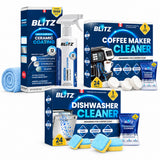
Shop BLITZ Coffee Maker Cleaner, $24.95
In this guide
Why coffee tastes bitter, sour or like vinegar after cleaning
A clean can leave something behind (cleaner, vinegar, loosened scale), and it changes how the machine brews. The exact taste tells you which one you're dealing with.
- Sour, sharp or like vinegar: acid left in the water path. Descalers and vinegar are acids. De'Longhi puts it plainly: if the machine wasn't properly rinsed after descaling, the coffee might taste acid.
- Salty, metallic or mineral: descaler and the scale it dissolved, still in the lines. Same fix: more rinsing.
- Soapy or chemical: soap or cleaner on a part you washed by hand, like the carafe, filter basket, brew unit or tank. De'Longhi says its fully automatic brewing units get water only, because detergents damage them.
- Bitter or harsh: usually not residue. Leftover acid tastes sour, not bitter, so bitterness points to the brew: dose, grind, beans or carafe film.
- Weak and sour, with a slow brew: scale is still inside (De'Longhi lists limescale itself as a cause of acidic coffee). Repeat the descale; with BLITZ, run a second cycle with a new tablet, as the directions say for heavy scale.
- White flakes or grit: scale the descaler loosened but didn't dissolve.

Start with the plain-water test
It tells you, in two minutes, whether the taste comes from the machine or from the coffee.
- Brew plain hot water (no pod, no grounds) into a clean ceramic mug at your usual cup size.
- Let it cool for a minute, then smell it and take a sip. Hot water from a well-rinsed machine tastes of nothing.
- Read the result. Sour, salty, soapy or vinegary: the machine needs more rinsing. Clean: the machine is fine, and the problem is in the brew (jump to that section).
Keurig's K-Mini guide says the same thing in its own words: you may need extra fresh-water rinses if you notice any residual taste.
Careful: Don't drink coffee that tastes of cleaner, and don't add more cleaner to fix it: that's just more to rinse out. Nespresso's descaling guides say never to swallow the solution. If someone drinks some, call the Centre antipoison du Québec at 1-800-463-5060 (free, 24/7), or 911 if they're unconscious or not breathing.
How many times should you rinse a coffee maker after descaling?
At least as many times as your maker asks, then more until the plain-water test passes. Here is what each maker's own guide says.

- Keurig K-Classic, K-Elite, Keurig 2.0: at least 12 largest-size brews, refilling the reservoir at least once. Models with Descale Mode (K-Supreme, K-Slim, K-Express): rinse until the DESCALE light goes off. K-Mini: 3 brews, more if you still taste it. Every model is in how to descale a Keurig.
- Nespresso Essenza Mini: 3 full tanks, because the tank is small. Vertuo Next: one full tank in the rinse phase, then let the machine rest 10 minutes. Nespresso also says to wipe the machine with a damp cloth afterwards.
- De'Longhi Dedica: two tanks filled to MAX, the second with the water filter back in. For its manual espresso makers, when coffee tastes acid after descaling, De'Longhi says to run 2 full tanks through the hot water spout and the boiler outlet.
- Breville Barista Express: refill the tank to its 2 L maximum with fresh cold water, then run the coffee, steam and hot water outlets again.
- Cuisinart Brew Central (DCC-1200C): one cycle of fresh cold water after Self Clean.
- Hamilton Beach drip: two carafes of cold water, says its FAQ; its how-to page says 2 to 3 brew cycles, letting the machine cool between them.
Tip: After vinegar, plan on more rinses: Breville's drip-machine advice is to repeat the rinse "to ensure no vinegar taste lingers," and De'Longhi warns that vinegar can leave a strong smell and an acid taste in coffee. More in coffee maker descaler vs vinegar.
How to rinse a coffee maker after cleaning, step by step
You need: fresh tap or filtered water (not distilled: Keurig says its brewers may not detect it), a large mug or container, and a sink. Time: 10 to 30 minutes, depending on the machine.
- Empty and rinse the tank. Pour out what's left of the solution and rinse the tank and its lid under the tap. Empty the drip tray and, on a pod machine, the used-capsule container.
- Fill it to MAX. A full tank flushes more than a partial one. De'Longhi notes that a Dedica asks for another rinse when the tank wasn't filled to MAX.
- Run water through every path the solution took. The largest cup size on a pod brewer; coffee, steam and hot water on an espresso machine; a full pot on a drip machine. Pour each cup down the sink.
- Repeat for your maker's count, and add extra tanks after vinegar.
- Put the water filter back, prepared. A new charcoal filter needs a soak first: 5 minutes for Breville, 15 minutes in cold tap water for Cuisinart.
- Rinse what touches the coffee. Run hot water over the carafe, filter basket and pod holder, and rinse twice if you washed them with dish soap.
- Run the plain-water test. Tastes of nothing: you're done. Anything else: one more full tank.

With BLITZ, the rinse is part of the directions: after the tablet cycle, throw out the water, wipe off any loosened residue and run at least one more full cycle of fresh water, so your coffee doesn't taste like the cleaner. In the photos from our product page, the first cycle came out yellowish and the final rinse ran clear. Rinse until yours does too.

White flakes or grit in the first cups
A descale can loosen scale faster than it dissolves it, so a few flakes may come out in the first cups, especially after a long gap between descales. That's mineral scale from your water, not the cleaner. None of the makers' guides we checked covers flakes directly, so this is our advice, built on their own cleaning steps:
- Run two more full tanks of plain water and pour each one down the sink.
- Clear the outlet. On a Keurig, clear the exit needle with a straightened paper clip, as Keurig's guides show. On a Breville espresso machine, wipe the group head and shower screen with a damp cloth and run a short flush through the empty portafilter.
- Rinse the filter basket and drip tray, where grit settles.
- Lots of flakes, or a slow, sputtering brew? More scale is inside: descale again. If a heavily scaled Keurig gives a small cup or none, Keurig says to unplug it, rinse and refill the reservoir, and repeat the fresh-water rinse.
Rinsed, plain water tastes clean, and the coffee is still bitter?
Then the machine is clean and the brew is the issue. Two causes tied to the clean are easy to miss:
- You were making up for scale. Breville says mineral buildup reduces brewing flow and temperature. If you'd moved to a finer grind or a bigger scoop to get a stronger cup from a scaled machine, the descaled machine now pulls more from that dose. Breville describes over-extracted espresso as very dark and bitter, from a grind too fine, too much coffee or tamping too hard.
- The carafe still has old coffee film. Descaling cleans the inside of the machine, not the carafe on the warming plate. Wash it and the filter basket, then rinse well.
Then reset the basics, one at a time:
- Dose: Cuisinart recommends 1 tablespoon (15 mL) of ground coffee per 5 oz (142 mL) cup on its drip machines, and notes the coffee-bar standard of 2 rounded tablespoons per 6 oz (175 mL).
- Grind: Cuisinart says a grind that's too fine causes over-extraction and bitterness, and recommends medium-fine for drip.
- Beans: Cuisinart suggests buying whole beans about two weeks' worth at a time.
Bitterness that started without any cleaning, or that none of this fixes, is a different problem: see why coffee suddenly tastes bitter.
Your first brews after cleaning: what to expect
Change one thing at a time. If the first cup after a clean is bitter and you also switched beans, you won't know which one did it.

If plain water still tastes of cleaner after your maker's rinse count plus two extra full tanks, stop and call the maker's support line (Keurig Canada: 1-800-361-5628) rather than adding anything else to the machine.
Why BLITZ makes the next clean easier
- One tablet, so there's never extra product to rinse out.
- One cycle for scale and coffee oils, so you don't need a separate cleaner and descaler (the two jobs are explained in coffee maker cleaning vs. descaling).
- No vinegar smell to chase. It's citric acid (the acid Keurig lists for its own solution), sodium carbonate and sodium lauryl glutamate, rinsed out with one full fresh-water cycle.
- About $1.04 a clean, a year in one box: $24.95 ÷ 24 tablets, at two cleanings a month, in pod (including K-Cup), drip and espresso machines.
- Rated 4.8 out of 5 (14 reviews) on goblitzclean.com.
- A Québec company based in Laval, with service in French and English. Free shipping in Canada from $40 ($7.95 under), 10% back in store credit, a 30-day money-back guarantee, and most orders in 2 to 3 business days. Also on Amazon.ca, without the store credit.
Frequently asked questions
Why does my coffee taste bitter after descaling?
Usually because the brew changed, not because of residue: leftover descaler tastes sour or salty more than bitter. Breville says scale reduces brewing flow and temperature, so once it's gone, a finer grind or bigger dose you'd used to compensate can over-extract. Do the plain-water test first, then go back to your usual dose and grind.
How do I get the vinegar taste out of my coffee maker?
Run full tanks of fresh water until a cup of plain hot water tastes and smells of nothing, and rinse the tank and carafe by hand. Hamilton Beach suggests 2 to 3 clean-water brew cycles after vinegar, letting the machine cool between them. Next time, a descaler avoids the smell altogether.
How many times should I run water through after descaling?
Your maker's count, from one full tank (Nespresso Vertuo Next, Breville Barista Express) to at least 12 brews (Keurig K-Classic, K-Elite), then until plain hot water tastes clean.
Is it safe to drink coffee that tastes like descaler?
Don't drink it: pour it out and keep rinsing. Nespresso says never to swallow descaling solution; if someone does, call the Centre antipoison du Québec at 1-800-463-5060.
Why does my coffee taste soapy after cleaning?
Soap or cleaner is on a part the coffee touches: carafe, filter basket, pod holder or brew unit. Rinse them well in hot water. De'Longhi's fully automatic brewing units get water only.
Why is there white stuff in my coffee after descaling?
Loosened scale. Our advice: run two more full tanks of plain water, clear the exit needle or wipe the shower screen, and rinse the filter basket. If flakes keep coming or the brew stays slow, descale again.
Sources: Keurig Canada's descaling page and Use & Care Guides for the K-Elite and K-Mini; Nespresso's Essenza Mini and Vertuo Next descaling guides; De'Longhi's Dedica descaling FAQ and acid taste support page; the Breville Barista Express instruction book; the Cuisinart Brew Central DCC-1200C booklet; Hamilton Beach Canada's coffee maker FAQ; the Centre antipoison du Québec. Checked October 19 and 20, 2026. Keurig, K-Cup, Nespresso, Vertuo, De'Longhi, Breville, Cuisinart and Hamilton Beach are trademarks of their owners. BLITZ is not affiliated with them.
ONE TABLET, ONE RINSE
BLITZ Coffee Maker Cleaner
Breaks down limescale, mineral buildup and coffee oils in one cycle, then one fresh-water cycle to rinse. Pod (including K-Cup), drip and espresso machines. 24 tablets for $24.95, about $1.04 a clean. Rated 4.8 out of 5 (14 reviews).

Free shipping in Canada from $40 · 30-day money-back guarantee


